

Updated Sep 16, 2026 Verified Pass PCNSE Exam in First Attempt Guaranteed
Free PCNSE Sample Questions and 100% Cover Real Exam Questions (Updated 375 Questions)
PCNSE: Target Audience
The target audience for the PCNSE certification exam is those candidates who want to demonstrate their knowledge of the Palo Alto Networks technologies, such as customers, partners, system & support engineers, as well as system integrators. This test also evaluates their skills in configuring implementations that are based on the Palo Alto Networks platform.
To earn the Palo Alto Networks PCNSE certification, candidates must pass a rigorous certification exam. PCNSE exam consists of 75 multiple-choice questions and is timed at 90 minutes. Candidates need to score at least 70% to pass the exam. PCNSE exam can be taken at a Pearson VUE testing center, and candidates need to register and pay the exam fee in advance.
NEW QUESTION # 157
An engineer configures a destination NAT policy to allow inbound access to an internal server in the DMZ. The NAT policy is configured with the following values:
- Source zone: Outside and source IP address 1.2.2.2
- Destination zone: Outside and destination IP address 2.2.2.1
The destination NAT policy translates IP address 2.2.2.1 to the real IP address 10.10.10.1 in the DMZ zone.
Which destination IP address and zone should the engineer use to configure the security policy?
- A. Destination Zone Outside. Destination IP address 10.10.10.1
- B. Destination Zone DMZ, Destination IP address 2.2.2.1
- C. Destination Zone DMZ, Destination IP address 10.10.10.1
- D. Destination Zone Outside. Destination IP address 2.2.2.1
Answer: B
NEW QUESTION # 158
Match each type of DoS attack to an example of that type of attack
Answer:
Explanation:
NEW QUESTION # 159
With the default TCP and UDP settings on the firewall, what will be the identified application in the following session?
- A. Incomplete
- B. unknown-tcp
- C. Insufficient-data
- D. not-applicable
Answer: A
Explanation:
Explanation
UDP connection on port 443. This would trigger unknown-udp. Incomplete is used in TCP connections only.https://knowledgebase.paloaltonetworks.com/KCSArticleDetail?id=kA10g000000ClibCAC
NEW QUESTION # 160
A firewall architect is attempting to install a new Palo Alto Networks NGFW. The company has previously had issues moving all administrative functions onto a data plane interface to meet the design limitations of the environment. The architect is able to access the device for HTTPS and SSH; however, the NGFW can neither validate licensing nor get updates. Which action taken by the architect will resolve this issue?
- A. Validate that all upstream devices will allow and properly route the outbound traffic to the external destinations needed
- B. Enable OCSP for the data plane interface so the firewall will create a certificate with the data plane interface's IP
- C. Create a service route that sets the source interface to the data plane interface in question
- D. Create a loopback from the management interface to the data plane interface, then make a service route from the management interface to the data plane interface
Answer: A
Explanation:
When administrative functions (e.g., licensing, updates) are moved to a data plane interface, the firewall uses that interface for outbound communication to Palo Alto Networks servers (e.g., licensing and update servers).
If HTTPS/SSH work but licensing/updates fail, the issue is likely upstream connectivity. Option B ensures that upstream devices (routers, firewalls) allow and route traffic to required destinations (e.g., updates.
paloaltonetworks.com) over ports like 443.
Option A (service route) assumes the interface is already set but doesn't address external routing. Option C (loopback) is unnecessary and complex. Option D (OCSP) relates to certificate validation, not licensing
/updates. Documentation emphasizes validating external connectivity.
Reference: PAN-OS 11.2 Administrator's Guide, "Device Management" section - Service Routes and Connectivity.
NEW QUESTION # 161
Which CLI command enables an administrator to check the CPU utilization of the dataplane?
- A. show running resource-monitor
- B. debug running resources
- C. show system resources
- D. debug data-plane dp-cpu
Answer: A
Explanation:
Explanation
https://knowledgebase.paloaltonetworks.com/KCSArticleDetail?id=kA10g000000ClXwCAK
NEW QUESTION # 162
An engineer is designing a deployment of multi-vsys firewalls.
What must be taken into consideration when designing the device group structure?
- A. Multiple vsys and firewalls can be assigned to a device group, and a multi-vsys firewall can have each vsys in a different device group.
- B. Only one vsys or one firewall can be assigned to a device group, except for a multi-vsys firewall, which must have all its vsys in a single device group.
- C. Only one vsys or one firewall can be assigned to a device group, and a multi-vsys firewall can have each vsys in a different device group.
- D. Multiple vsys and firewalls can be assigned to a device group, and a multi-vsys firewall must have all its vsys in a single device group.
Answer: A
Explanation:
Explanation
https://knowledgebase.paloaltonetworks.com/KCSArticleDetail?id=kA10g000000ClETCA0 A device group is a logical grouping of firewalls that share the same security policy rules. A device group can contain multiple vsys and firewalls, including multi-vsys firewalls. A multi-vsys firewall can have each vsys in a different device group, depending on the desired security policy for each vsys. This allows for granular control and flexibility in managing multi-vsys firewalls with Panorama1. References: Device Group Push to a Multi-VSYS Firewall, Configure Virtual Systems, PCNSE Study Guide (page 50)
NEW QUESTION # 163
An engineer is deploying multiple firewalls with common configuration in Panorama.
What are two benefits of using nested device groups? (Choose two.)
- A. Inherit parent Security policy rules and objects
- B. Inherit IPSec crypto profiles
- C. Inherit settings from the Shared group
- D. Inherit all Security policy rules and objects
Answer: A,C
Explanation:
https://docs.paloaltonetworks.com/panorama/9-1/panorama-admin/panorama- overview/centralized-firewall-configuration-and-update-management/device-groups/device-group- hierarchy
NEW QUESTION # 164
An administrator has been asked to create 100 virtual firewalls in a local, on-premise lab environment (not in "the cloud"). Bootstrapping is the most expedient way to perform this task.
Which option describes deployment of a bootstrap package in an on-premise virtual environment?
- A. Use a virtual CD-ROM with an ISO.
- B. Create and attach a virtual hard disk (VHD).
- C. Use an S3 bucket with an ISO.
- D. Use config-drive on a USB stick.
Answer: A
NEW QUESTION # 165
After configuring HA in Active/Passive mode on a pair of firewalls the administrator gets a failed commit with the following details.
What are two explanations for this type of issue? (Choose two)
- A. The peer IP is not included in the permit list on Management Interface Settings
- B. One of the firewalls has gone into the suspended state
- C. Either management or a data-plane interface is used as HA1-backup
- D. The Backup Peer HA1 IP Address was not configured when the commit was issued
Answer: C,D
Explanation:
Cause The issue is seen when the HA1-backup is configured with either management (MGT) or an in-band interface. The "Backup Peer HA1 IP Address" is not configured : https://knowledgebase.paloaltonetworks.com/KCSArticleDetail?id=kA14u0000008UmPCAU&lang=en_US%E2%80%A9
NEW QUESTION # 166
An organization is interested in migrating from their existing web proxy architecture to the Web Proxy feature of their PAN-OS 11.0 firewalls. Currently. HTTP and SSL requests contain the c IP address of the web server and the client browser is redirected to the proxy Which PAN-OS proxy method should be configured to maintain this type of traffic flow?
- A. DNS proxy
- B. SSL forward proxy
- C. Explicit proxy
- D. Transparent proxy
Answer: D
Explanation:
Explanation
A transparent proxy is a type of web proxy that intercepts and redirects HTTP and HTTPS requests without requiring any configuration on the client browser1. The firewall acts as a gateway between the client and the web server, and performs security checks on the traffic.
A transparent proxy can be configured on PAN-OS 11.0 firewalls by performing the following steps1:
Enable Web Proxy under Device > Setup > Services
Select Transparent Proxy as the Proxy Type
Configure a Service Route for Web Proxy
Configure SSL/TLS Service Profile for Web Proxy
Configure Security Policy Rules for Web Proxy Traffic
By configuring a transparent proxy on PAN-OS 11.0 firewalls, an organization can migrate from their existing web proxy architecture without changing their network topology or client settings2. The firewall will maintain the same type of traffic flow as before, where HTTP and HTTPS requests contain the IP address of the web server and the client browser is redirected to the proxy1.
Answer A is not correct because DNS proxy is a type of web proxy that intercepts DNS queries from clients and resolves them using an external DNS server3. This type of proxy does not redirect HTTP or HTTPS requests to the firewall.
NEW QUESTION # 167
An administrator is configuring an IPSec VPN to a Cisco ASA at the administrator's home and experiencing issues completing the connection. the following is the output from the command:
What could be the cause of this problem?
- A. The public IP addresses do not match for both the Palo Alto Networks Firewall and the ASA.
- B. The dead peer detection settings do not match between the Palo Alto Networks Firewall and the ASA.
- C. The Proxy IDs on the Palo Alto Networks Firewall do not match the setting on the ASA.
- D. The shared secrets do not match between the Palo Alto Networks Firewall and the ASA.
Answer: A
NEW QUESTION # 168
A firewall administrator is configuring an IPSec tunnel between a company's HQ and a remote location. On the HQ firewall, the interface used to terminate the IPSec tunnel has a static IP. At the remote location, the interface used to terminate the IPSec tunnel has a DHCP assigned IP address.
Which two actions are required for this scenario to work? (Choose two.)
- A. On the HQ firewall enable DDNS under the interface used for the IPSec tunnel
- B. On the remote location firewall select peer IP address type Dynamic
- C. On the HQ firewall select peer IP address type FQDN
- D. On the remote location firewall enable DONS under the interface used for the IPSec tunnel
Answer: A,C
NEW QUESTION # 169
A network security engineer is asked to provide a report on bandwidth usage. Which tab in the ACC provides the information needed to create the report?
- A. Bandwidth Activity
- B. Blocked Activity
- C. Network Activity
- D. Threat Activity
Answer: C
Explanation:
The Network Activity tab of the Application Command Center (ACC) displays an overview of traffic and user activity on your network including:
Top applications in use
Top users who generate traffic (with a drill down into the bytes, content, threats or URLs accessed by the user) Most used security rules against which traffic matches occur In addition, you can also view network activity by source or destination zone, region, or IP address, ingress or egress interfaces, and GlobalProtect host information such as the operating systems of the devices most commonly used on the network.
https://docs.paloaltonetworks.com/pan-os/9-1/pan-os-web-interface-help/acc/acc-tabs
NEW QUESTION # 170
Which log type would provide information about traffic blocked by a Zone Protection profile?
- A. Traffic
- B. Threat
- C. Data Filtering
- D. IP-Tag
Answer: B
Explanation:
https://knowledgebase.paloaltonetworks.com/KCSArticleDetail?id=kA10g000000ClhzCAC
* D is the correct answer because the threat log type would provide information about traffic blocked by a Zone Protection profile. This is because Zone Protection profiles are used to protect the network from attacks, including common flood, reconnaissance attacks, and other packet-based attacks1. These attacks are classified as threats by the firewall and are logged in the threat log2. The threat log displays information such as the source and destination IP addresses, ports, zones, applications, threat types, actions, and severity of the threats2.
Verified References:
* 1: Zone protection profiles - Palo Alto Networks Knowledge Base
* 2: Threat Log Fields - Palo Alto Networks
NEW QUESTION # 171
Panorama provides which two SD-WAN functions? (Choose two.)
- A. control plane
- B. network monitoring
- C. data plane
- D. physical network links
Answer: A,B
Explanation:
https://www.paloaltonetworks.com/resources/guides/sd-wan-architecture-guide
https://docs.paloaltonetworks.com/sd-wan/1-0/sd-wan-admin/sd-wan-overview/about-sd-wan.html
(Network Monitoring & Control Plane). Data plane & Physical Interfaces are directly taken care through Firewalls where SD WAN is enabled.
NEW QUESTION # 172
A company has configured a URL Filtering profile with override action on their firewall. Which two profiles are needed to complete the configuration? (Choose two)
- A. SSL/TLS Service
- B. Decryption
- C. HTTP Server
- D. Interface Management
Answer: A,D
Explanation:
Explanation
https://docs.paloaltonetworks.com/pan-os/10-2/pan-os-admin/url-filtering/allow-password-access-to-certain-sites
NEW QUESTION # 173
A company wants to install a NGFW firewall between two core switches on a VLAN trunk link. They need to assign each VLAN to its own zone and to assign untagged (native) traffic to its own zone.
Which option differentiates multiple VLANs into separate zones?
- A. Create V-Wire objects with two V-Wire subinterfaces and assign only a single VLAN ID to the "Tag Allowed" field of the V-Wire object. Repeat for every additional VLAN and use a VLAN ID of 0 for untagged traffic. Assign each interface/subinterface to a unique zone.
- B. Create VLAN objects for each VLAN and assign VLAN interfaces matching each VLAN ID. Repeat for every additional VLAN and use a VLAN ID of 0 for untagged traffic. Assign each interface/subinterface to a unique zone.
- C. Create Layer 3 subinterfaces that are each assigned to a single VLAN ID and a common virtual router. The physical Layer 3 interface would handle untagged traffic. Assign each interface/subinterface to a unique zone. Do not assign any interface an IP address.
- D. Create V-Wire objects with two V-Wire interfaces and define a range of "0-4096" in the "Tag Allowed" field of the V-Wire object.
Answer: C
NEW QUESTION # 174
Match each SD-WAN configuration element to the description of that element.
Answer:
Explanation: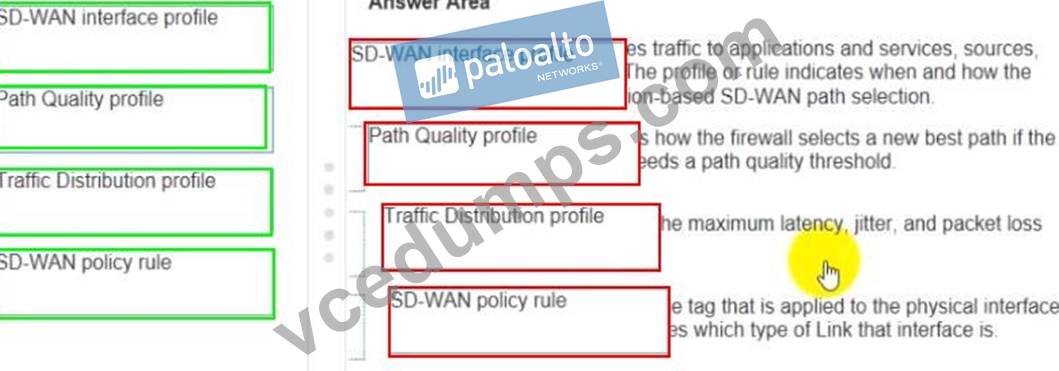
NEW QUESTION # 175
Refer to Exhibit: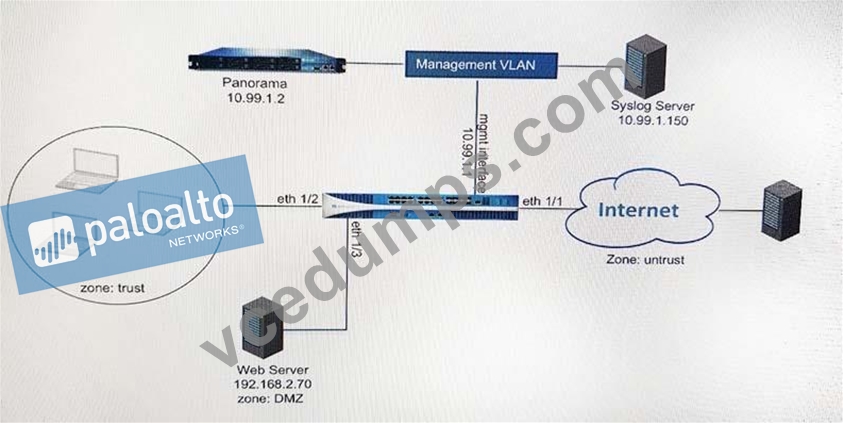
An administrator can not see any Traffic logs from the Palo Alto Networks NGFW in Panorama reports.
The configuration problem seems to be on the firewall.
Which settings, if configured incorrectly, most likely would stop only Traffic logs from being sent from the NGFW to Panorama?
- A. Option B
- B. Option C
- C. Option D
- D. Option A
Answer: B
NEW QUESTION # 176
When configuring explicit proxy on a firewall, which interface should be selected under the Listening interface option?
- A. ingress for the outgoing traffic to the internet
- B. Loopback for the proxy
- C. Firewall management
- D. ingress for the client traffic
Answer: B
Explanation:
When configuring an explicit proxy on a firewall, the Loopback interface is typically selected under the Listening interface option. The loopback interface is used because it allows the firewall to listen for proxy traffic independently of any specific physical interface. This is ideal for situations where the proxy should listen for connections from clients, regardless of which interface they come from.
While interfaces like Ingress (client-side) and Egress (internet-side) may handle the traffic flow, the loopback interface ensures that the proxy can handle requests from any source without being tied to a specific physical interface.
NEW QUESTION # 177
......
Download Real Palo Alto Networks PCNSE Exam Dumps Test Engine Exam Questions: https://testinsides.vcedumps.com/PCNSE-examcollection.html
