

Pass Palo Alto Networks XSIAM-Engineer Exam Quickly With VCEDumps
Prepare XSIAM-Engineer Question Answers - XSIAM-Engineer Exam Dumps
Palo Alto Networks XSIAM-Engineer Exam Syllabus Topics:
| Topic | Details |
|---|---|
| Topic 1 |
|
| Topic 2 |
|
| Topic 3 |
|
| Topic 4 |
|
NEW QUESTION # 93
A critical XSIAM Playbook for responding to malware outbreaks frequently fails due to rate limiting from an external reputation service API. The Playbook uses a 'Generic API Call' task for this. The XSIAM team wants to implement a robust retry mechanism with exponential backoff and a circuit breaker pattern within the Playbook itself to handle these transient failures. Which XSIAM Playbook feature or combination of features would be most appropriate to achieve this without requiring external scripting beyond the Playbook tasks?
- A. Leveraging XSIAM's internal 'Task Group' feature to automatically retry the failed task a fixed number of times.
- B. Using a 'Loop' task with a 'Conditional' check for API success and a 'Sleep' task inside the loop.
- C. Implementing a custom 'Python Script' task that handles the retry logic, exponential backoff, and circuit breaker states.
- D. Configuring the 'Generic API Call' task's built-in retry options (if available) and defining a 'Failure Path' to a 'Manual Review' task.
- E. Defining a global XSIAM system setting for API retries across all playbooks.
Answer: C
Explanation:
While some 'Generic API Call' tasks might have basic retry mechanisms, implementing a full exponential backoff and circuit breaker pattern within a Playbook task without external scripting (as implied by 'within the Playbook itself) requires programmatic control. A 'Python Script' task allows for granular control over HTTP requests, including custom retry loops, backoff algorithms, and state management for a simple circuit breaker. 'Loop' with 'Sleep' can do basic retries but not exponential backoff or circuit breaker logic efficiently. Built-in retry options are often limited. 'Task Group' is for grouping, not retry logic. Global settings don't exist for this granularity.
NEW QUESTION # 94
A security analyst needs to install a Cortex XSIAM agent on a critical Linux server. The server is hardened and has no internet access, but can reach a local HTTP server hosting the agent installer. The analyst wants to ensure the agent is installed with a specific proxy configuration and is immediately assigned to the 'Critical _ Servers' agent group. Which command combination is most appropriate?
- A.

- B.

- C.

- D.

- E.

Answer: E
Explanation:
Option E is the most accurate and complete. Cortex XSIAM agent installers for Linux typically accept parameters like '-proxy-string' (or similar, depending on version) to define proxy settings and 'group-name' to assign the agent to a specific group. A crucial element missing in other options (or incorrectly represented) is the installation token, which is unique to your XSIAM tenant and required for agent registration. While HTTP PROXY environment variable might work for swgetTcurl&, the agent installer itself needs explicit parameters for its own communication. The 'token" parameter is mandatory for the agent to register with your specific XSIAM instance. The exact parameter names might vary slightly with XSIAM versions, but '--proxy-string', '--group-name' , and '--token' are standard concepts.
NEW QUESTION # 95
A security architect is planning the deployment of Cortex XSIAM in a hybrid cloud environment. The organization requires ingest of logs from on-premises Active Directory Domain Controllers, Splunk Enterprise Security, and AWS CloudTrail. The design mandates high availability and geographic redundancy for log collection. Which of the following considerations are critical for the Broker VM deployment to meet these requirements?
- A. Configuring a load balancer in front of the Broker VM to distribute incoming log traffic for high availability.
- B. Ensuring the Broker VM has direct L3 network reachability to all log sources without NAT or firewall intervention.
- C. Utilizing multiple Broker VMS distributed across different geographical locations, each configured with local data sources.
- D. Allocating dedicated public IP addresses for each Broker VM to facilitate direct internet access from cloud log sources.
- E. Deploying a single Broker VM in a central datacenter with high-bandwidth internet connectivity to the Cortex XSIAM cloud.
Answer: C
Explanation:
For high availability and geographic redundancy, deploying multiple Broker VMS distributed across different geographical locations, each handling local data sources, is the most critical consideration. A single Broker VM creates a single point of failure and bottleneck. While connectivity is important, it's not the primary architectural decision for redundancy.
NEW QUESTION # 96
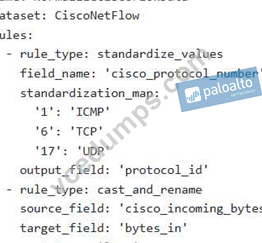
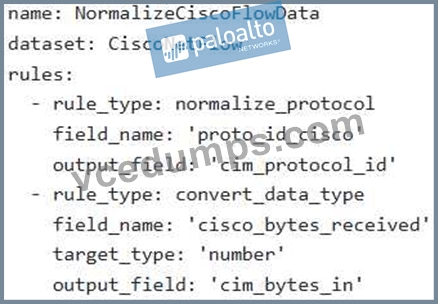
A large-scale XSIAM deployment aggregates network flow data from various vendors (e.g., Palo Alto Networks firewalls, Cisco switches, cloud flow logs). Each vendor reports similar flow attributes ('source_ip', 'destination_ip', 'bytes_in', 'bytes_out', 'protocol_id', 'port_number') but with different field names and sometimes different data types (e.g., 'protocol_id' as integer vs. string protocol name). To enable unified querying and analysis across all flow sources, the XSIAM team needs to deploy data modeling rules that standardize these attributes. Provide an example of an XSIAM content optimization rule (conceptual YAML/JSON structure) that achieves this normalization for 'protocol_id' and 'bytes_in' from a hypothetical 'CiscoNetFlow' dataset into XSIAM's Common Information Model (CIM) equivalent fields.
- A.
- B.

- C.

- D.
- E.

Answer: A,E
Explanation:
The goal is to normalize inconsistent field names and data types from different vendors into a CIM-like structure using XSIAM content optimization rules, specifically for 'protocol_id' and 'bytes_in'. Option A: Is a strong candidate. - 'map_field' : Directly addresses the conversion of 'protocol_id' (e.g., integer '6') to a string 'TCP', which is a common normalization task when source systems use numeric codes while the target (CIM) expects readable names. - 'transform_field' with 'to_integer': Directly addresses the data type conversion for 'bytes_in' (assuming 'in_byteS might be a string or other non-integer type) and renames it to the CIM equivalent. Option E: Is also a strong candidate and very similar to A, demonstrating alternative syntax or rule types. - 'standardize_values': This rule type explicitly handles mapping multiple source values to a single standard output value for 'protocol_id', which is exactly what's needed for 'protocol_id' normalization. - This rule type combines both data type casting (e.g., ensuring 'bytes_in' is a ' long' integer) and field renaming in a single, clear step. This is a very common and efficient way to normalize data types and names simultaneously. Why others are less optimal: - B : Uses generic 'normalize_protocor and rule types which are conceptually correct but the provided YAML snippet is less specific to XSIAM's typical syntax than A or E, and 'normalize_protocol' is vague without an explicit mapping. 'output_field' is redundant if renaming is implied by 'target_type' . - C : 'extract_regex' is for pulling data from unstructured strings, not mapping existing structured fields. 'calculate_field' for implies a calculation, not just a type conversion and rename, and 'cisco_input_octets / 8' is an unnecessary conversion (bytes are bytes, not bits, unless explicitly stated). - D : 'rename_field' is good for names, but 'enrich_field' with a 'lookup_table' for 'bytes_in' is nonsensical for a simple type conversion. Enrichment is for adding new context, not changing the type of an existing numerical field.
NEW QUESTION # 97
Consider the following XSIAM playbook action snippet intended to update an incident artifact. An engineer reports that while the playbook runs without errors, the incident artifact is not being updated as expected.
Which of the following is the most likely reason for the incident artifact not being updated with the new 'threat_score' and 'last_seen' fields?
- A. Option D
- B. Option E
- C. Option B
- D. Option A
- E. Option C
Answer: E
Explanation:
While 'D' (empty enrichment_result) would prevent data from being added, and 'A' (incorrect operation) could cause issues, the most fundamental reason for custom fields not being updated or appearing is that they haven't been properly defined in the XSIAM data model. For custom fields like 'threat_score' or 'last_seen' to be associated with an artifact type (like 'IP Address'), they must be explicitly defined in a Content Pack as part of the artifact's schema. Without this definition, XSIAM doesn't know how to store or display these new fields, even if the playbook attempts to set them. The 'append' operation for artifacts typically adds a new artifact if not found or updates its labels if found; for existing artifact's fields_, the fields themselves need to exist in the schema.
NEW QUESTION # 98
A global manufacturing company is planning an XSIAM deployment. A critical data source is log data from their Operational Technology (OT) environment, which includes SCADA systems, PLCs, and historians. These systems produce unique, proprietary binary log formats and often use non-standard communication protocols (e.g., Modbus/TCP, OPC UA). What strategic considerations are paramount for successfully integrating this OT data into XSIAM, beyond standard IT data sources?
- A. It is essential to deploy specialized OT security solutions (e.g., dedicated IDS/IPS for industrial protocols, OT-aware log collectors) within the Purdue Model's Level 1-2 to normalize and securely forward data to XSIAM, respecting network segmentation.
- B. The primary focus should be on converting all OT data to CEF or LEEF format using generic industrial protocol converters and sending it directly to XSIAM's cloud tenant.
- C. Collaboration with OT engineers is critical to understand proprietary protocols, log structures, and the impact of any data collection activities on production, ensuring minimal disruption and proper data interpretation.
- D. Due to the sensitive nature of OT, only aggregate statistics or 'summary of summaries' should be sent to XSIAM, with raw OT logs stored locally in the OT network.
- E. Prioritize the ingestion of event logs from Windows-based HMIs (Human-Machine Interfaces) as they are the most familiar and easiest to integrate using standard XSIAM collectors.
Answer: A,C
Explanation:
Integrating OT data is fundamentally different from IT. Option B is critical because direct integration with proprietary OT protocols is complex and risky. Specialized OT security solutions are designed to safely collect, normalize, and often parse these unique logs, acting as secure conduits to IT security platforms like XSIAM, while respecting the strict segmentation of the Purdue Model. Option E emphasizes the crucial need for collaboration with OT engineers. Their domain expertise is indispensable for understanding the operational impact of data collection, interpreting proprietary log formats, and ensuring data integrity and system stability. Option A is oversimplified; generic converters may not handle proprietary formats effectively. Option C only covers a small subset of OT logs. Option D severely limits visibility for effective threat detection and incident response.
NEW QUESTION # 99
As a Palo Alto Networks XSIAM Engineer, you are tasked with creating a highly specialized ASM rule to identify 'Domain Fronting' attempts originating from internal client machines, targeting known legitimate content delivery networks (CDNs) but with suspicious 'Host' headers pointing to unapproved external domains. This requires deep inspection of HTTP headers. Assume XSIAM can process full HTTP session details. Which XQL construct and data source is most suitable?
- A.

- B.

- C.

- D.

- E.

Answer: C
Explanation:
Option B is the most appropriate. 'Domain Fronting' specifically manipulates the HTTP Host header. Therefore, 'xdr_http_sessions' is the ideal dataset as it provides parsed HTTP header information. The XQL query accurately filters for traffic to legitimate CDNs and then uses the 'alter' command with a 'case' statement to check if the 'Host:' header content differs from the actual 'dest_address' (the CDN domain). This logic directly identifies the core characteristic of domain fronting. Option A is too high-level (network sessions, not HTTP headers). Option C focuses on DNS, not the HTTP layer. Option D looks at a specific tool's command line, not all HTTP traffic. Option E relies on raw logs, which is inefficient and error-prone for structured data like HTTP headers.
NEW QUESTION # 100
A large enterprise uses XSIAM for threat detection. They've detected multiple instances of 'Suspicious API Call' alerts originating from a specific internal application. These alerts are high volume but often represent legitimate (though unusual) behavior. The SOC wants to reduce the criticality of these specific alerts while maintaining the detection logic for other applications. Which set of XSIAM content optimization actions are most appropriate to achieve this goal? (Select all that apply)
- A. Modify the 'Suspicious API Call' detection rule directly to exclude the specific internal application's activity, thus preventing the alerts from being generated at all.
- B. Configure an automation playbook to automatically close all 'Suspicious API Call' alerts from the specific application within 5 minutes of generation.
- C. Utilize XSIAM's 'Alert Grouping' feature to consolidate these high-volume, low-criticality alerts into a single incident, reducing individual alert fatigue while maintaining visibility.
- D. Develop a custom 'Reputation List' in XSIAM containing the specific application's process hash or IP, and then create a scoring rule that applies a 'Multiplicative Score Change' of less than 1.0 (e.g., x0.5) to alerts involving entities on this reputation list.
- E. Create a new scoring rule with a high 'Order' that, for alerts matching 'Suspicious API Call' and originating from the specific internal application, applies an 'Additive Score Change' with a negative value (e.g., -50).
Answer: D,E
Explanation:
Options B and C are the most appropriate content optimization actions. Option B (Negative Additive Score Change): This directly reduces the score of specific alerts, lowering their criticality and helping to de-prioritize them in the SOC queue without losing the detection. Using a high 'Order' ensures it's applied after initial scoring. Option C (Multiplicative Score Change with Reputation List): This is a scalable and best- practice approach. By defining the legitimate application's entities in a reputation list and applying a multiplicative factor less than 1.0, you proportionally reduce the score for all related alerts. This is dynamic and can be reused. Option A (Modify Detection Rule): While it would stop the alerts, it's generally not recommended for 'legitimate but unusual' behavior. It creates a blind spot. If the behavior changes to truly malicious, the detection would be missed. Content optimization often aims to reduce noise, not eliminate detection. Option D (Automation Playbook): This addresses alert handling after scoring and triage. It doesn't reduce the initial criticality or visibility in the queue; it just automates closure, which might still mean analysts see them initially. Option E (Alert Grouping): While useful for managing alert volume and reducing fatigue, it doesn't directly reduce the criticality score of the individual alerts. It helps in incident management but isn't a direct scoring optimization.
NEW QUESTION # 101
An organization is migrating its cloud infrastructure from AWS to Azure, while simultaneously planning for XSIAM adoption. They heavily utilize serverless functions (AWS Lambda, Azure Functions) and containerized applications (EKS, AKS). What challenges might arise in collecting comprehensive telemetry from these ephemeral and dynamic cloud-native components, and how does XSIAM address these?
- A. Challenge: Inability to deploy traditional network-based sensors. XSIAM addresses this by performing agentless network scanning of the cloud environment.
- B. Challenge: Dynamic scaling and short lifespans make consistent monitoring difficult. XSIAM addresses this by integrating directly with cloud provider APIs (e.g., CloudWatch, Azure Monitor, Activity Logs) and leveraging specialized collectors for container runtime security (e.g., Cortex XDR for Containers).
- C. Challenge: Increased network egress costs due to telemetry forwarding. XSIAM addresses this by compressing all telemetry data by 95% before ingestion.
- D. Challenge: Ephemeral nature makes traditional agent deployment difficult. XSIAM addresses this by requiring agents to be baked into container images and serverless runtimes.
- E. Challenge: Lack of persistent file systems for log storage. XSIAM addresses this by automatically deploying dedicated persistent storage volumes for each serverless function and container.
Answer: B
Explanation:
Ephemeral and dynamic cloud-native components (serverless, containers) present significant challenges for traditional monitoring. Their short lifespans and frequent scaling make persistent agent deployment or manual log configuration impractical. XSIAM tackles this by leveraging direct API integrations with cloud providers' native logging and monitoring services (e.g., AWS CloudWatch, Azure Monitor, Azure Activity Logs) and specialized collectors for container environments (Cortex XDR for Containers). This allows XSIAM to ingest logs, metrics, and runtime activity from these dynamic workloads without requiring a persistent agent on every ephemeral instance.
NEW QUESTION # 102
A company is migrating from a traditional SIEM to XSIAM. They have a legacy application that generates logs in a highly customized, non-standard XML format, and the application's development team is no longer available to modify its logging mechanism. The logs are critical for compliance and incident forensics. What is the most effective strategy to ensure these logs are ingested into XSIAM with proper normalization and enrichment for analysis?
- A. Decommission the legacy application, as its logs cannot be efficiently integrated into XSIAM.
- B. Develop a custom Python script using the
- C. Upload the raw XML files periodically to an S3 bucket and configure XSIAM to ingest them, relying on XSIAM's out-of-the-box machine learning for parsing.
- D. Manually create AQL parsing rules within XSIAM for the XML logs, iterating on them as new log patterns emerge.
- E. Utilize a commercial log parser or ETL tool (e.g., Splunk's Heavy Forwarder, Logstash with XML filter) as an intermediary to convert the XML into a standard format before forwarding to XSIAM.
Answer: B,E
Explanation:
Both A and B are viable and effective strategies. A custom Python script (A) offers maximum flexibility and control for complex transformations of XML into a XSlAM-compatible format like JSON or CEF, which can then be ingested. A commercial ETL tool (B) can provide a more managed and potentially faster solution for complex parsing and transformation if available and within budget, often with built-in features for handling various data formats. Option C is unreliable for complex, custom XML. Option D is highly inefficient and not scalable for dynamic logs. Option E is not a practical solution for critical compliance/forensic data.
NEW QUESTION # 103
During a rule review, an XSIAM engineer identifies a correlation rule that consistently triggers false positives due to a common, legitimate system process that temporarily matches a suspicious pattern. Simply adding the process name to a global exclusion list is not an option, as the process could still be malicious under different circumstances. How can this specific false positive scenario be mitigated without losing the rule's overall detection capability for actual threats?
- A. Reduce the rule's severity to 'informational' so it generates fewer alerts.
- B. Increase the time window for the correlation to 24 hours, making it less likely to catch short-lived legitimate activity.
- C. Create a post-detection automation playbook that automatically closes alerts generated by this specific process, without analyzing the underlying conditions.
- D. Disable the rule for a week and then re-enable it to see if the false positives subside.
- E.

Answer: E
Explanation:
Option B is the most precise and effective method. By implementing a conditional exclusion, you can specify exact circumstances under which the legitimate process should NOT trigger an alert, while still allowing the rule to catch instances where the same process might be used maliciously (e.g., if its parent process or command line arguments differ). This maintains the rule's fidelity for true threats while eliminating specific false positives. Options A, C, D, and E are either ineffective, harmful to detection, or merely reactive.
NEW QUESTION # 104
A distributed organization with multiple branch offices, each with limited local IT staff, needs to deploy Cortex XSIAM agents. Network bandwidth to the main data center and the internet can be a constraint at these branches. How can the deployment strategy be optimized to minimize bandwidth consumption during the initial installation and subsequent agent updates?
- A. Implement QOS policies on branch office routers to prioritize XSIAM agent traffic over other network activities, ensuring agents always get sufficient bandwidth.
- B. Pre-stage agent installers on USB drives and manually install them at each branch office. For updates, disable automatic updates and manually push them quarterly.
- C. Distribute agent installers via an existing software distribution system (e.g., SCCM, Jamf) with local distribution points at each branch, and configure agents to receive content updates from a content caching proxy if supported by XSIAM.
- D. Utilize a local XSIAM broker or content caching solution (if available) at each branch office to serve agent installers and updates, reducing outbound internet traffic from individual endpoints.
- E. Centralize all agent installers on a single web server in the main data center. Agents will pull updates directly from the XSIAM cloud, assuming minimal impact.
Answer: C,D
Explanation:
Both B and E are effective strategies. Option B suggests using a local XSIAM broker or content caching solution, which is directly designed to optimize content delivery in distributed environments by acting as a local repository for agent installers and updates, thus reducing individual agent calls to the cloud and conserving branch bandwidth. Option E details a common enterprise software distribution approach using existing infrastructure like SCCM or Jamf with local distribution points. This offloads the initial installer download from the main internet connection. Additionally, configuring agents to use a content caching proxy (if XSIAM supports this feature, which it does in some contexts) further optimizes update traffic. Option A would exacerbate bandwidth issues. Option C is manual, not scalable, and delays critical security updates. Option D is a network-level control that doesn't reduce the total data transferred, only prioritizes it, which might still strain limited bandwidth.
NEW QUESTION # 105
A sophisticated attacker has managed to compromise an XSIAM instance by exploiting a vulnerability in a custom content pack's integration code. The vulnerability allowed arbitrary command execution on the XSOAR engine. Post-incident, to prevent such recurrences and improve content pack security, which of the following measures should be prioritized during development and maintenance?
- A. Run all custom integrations in isolated Docker containers with minimal necessary privileges and strict resource limits.
- B. Utilize XSIAM's built-in 'Execution Whitelisting' feature to explicitly define which commands and scripts are allowed to run from custom content packs.
- C. Implement input validation and sanitization for all external data consumed by custom integrations, especially when used in shell commands or file paths.
- D. Ensure that the XSOAR engine host's operating system and all its dependencies are regularly patched and updated to the latest stable versions.
- E. Conduct regular security audits of all custom content pack code, including static analysis (SAST) and dynamic analysis (DAST) before deployment to production.
Answer: A,B,C,D,E
Explanation:
This is a multiple-response question, and all options contribute significantly to improving content pack security and preventing arbitrary command execution vulnerabilities. -A (Input Validation/Sanitization): Directly addresses common vulnerabilities like command injection by ensuring untrusted input cannot be executed as code or used to manipulate file paths. - B (Container Isolation/Least Privilege): XSOAR integrations run within containers. Ensuring these containers have minimal necessary privileges (e.g., read-only access to specific directories) and resource limits (CPU, memory) significantly limits the blast radius of a successful exploit. - C (Code Audits/SAST/DAST): Proactive security testing is crucial to identify vulnerabilities in the code itself before deployment. SAST can find common code flaws, and DAST (if applicable, for web-facing integrations) can test runtime vulnerabilities. - D (Execution Whitelisting): This XSOAR feature allows administrators to explicitly define a whitelist of allowed commands and scripts, preventing unauthorized execution even if a vulnerability allows an attacker to attempt it. - E (Patching OS/Dependencies): A fundamental security hygiene practice. Even if your content pack code is perfect, vulnerabilities in the underlying OS or its libraries (e.g., Python runtime, network libraries) can be exploited to gain control.
NEW QUESTION # 106
An organization is deploying Broker VMS in geographically dispersed datacenters. They employ a strict network access control policy that restricts outbound internet access. All outbound traffic must traverse a corporate proxy server that performs SSL inspection. How can the Broker VM be configured to reliably communicate with the Cortex XSIAM cloud under these conditions, including managing certificate trust for SSL inspection?
- A. Option D
- B. Option E
- C. Option A
- D. Option B
- E. Option C
Answer: C
Explanation:
To communicate through a corporate proxy with SSL inspection, the Broker VM needs two primary configurations: 1. Proxy settings: The Broker VM installation process or post-deployment configuration allows specifying proxy server details (IP/port). 2. Certificate Trust: Since the proxy performs SSL inspection, it re-signs the XSIAM certificates with its own CA. The Broker VM must trust this corporate proxy's root CA. This is achieved by uploading the proxy's root CA certificate to the Broker VM's trust store, typically using the provided Palo Alto Networks utility like Option B is insecure and not recommended. Option C bypasses the proxy, which violates the strict policy. Option certificate bundle installer. sh. D is incorrect; automatic detection and trusting all certificates is not how it works. Option E adds unnecessary complexity by introducing another proxy layer.
NEW QUESTION # 107
An XSIAM administrator is reviewing the audit logs for user activity and notices suspicious API calls originating from a compromised service account. The API key associated with this service account has 'Security Operations Center - Admin' permissions. The immediate action is to revoke the compromised API key. Which of the following XSIAM commands or API operations would be used to revoke a specific API key, assuming you have the necessary administrative privileges?
- A. Option D
- B. Option E
- C. Option A
- D. Option C
- E. Option B
Answer: D,E
Explanation:
Both the XSIAM UI and the XSIAM API provide mechanisms to revoke API keys. Option B describes the direct IJI approach, which is straightforward for administrators. Option C describes the typical REST API approach for deleting a resource, where DELETE requests are used to revoke or remove API keys. Option A is a pseudocode function call that might be part of an SDK, but not a direct API endpoint. Option D is an extreme measure that would disrupt all API integrations and is not the targeted way to revoke a single key. Option E is an unsupported and dangerous method of configuration management.
NEW QUESTION # 108
A Behavioral Threat Protection (BTP) alert is triggered with an action of "Prevented (Blocked)" on one of several application servers running Windows Server 2022. The investigation determines the involved processes to be legitimate core OS binaries, and the description from the triggered BTP rule is an acceptable risk for the company to allow the same activity in the future.
This type of activity is only expected on the endpoints that are members of the endpoint group "AppServers," which already has a separate prevention policy rule with an exceptions profile named "Exceptions- AppServers" and a malware profile named "Malware-AppServers." The CGO that was terminated has the following properties:
SHA256: eb71ea69dd19f728ab9240565e8c7efb59821e19e3788e289301e1e74940c208 File path: C:\Windows\System32\cmd.exe Digital Signer: Microsoft Corporation How should the exception be created so that it is scoped as narrowly as possible to minimize the security gap?
- A. Create the exception via the alert itself, selecting the CGO hash, CGO signer, CGO process path, and applying the scope to "Global."
- B. Create the exception via the alert itself, selecting the CGO hash, CGO signer, CGO process path, and applying the scope to the "Exceptions-AppServers" profile.
- C. Create a Disable Prevention Rule via Exceptions Configuration with the following selections:

- D. Create a Legacy Agent Exception via Exceptions Configuration with the following selections:

Answer: C
Explanation:
The most secure approach is to create a Disable Prevention Rule via Exceptions Configuration, scoped specifically to the Exceptions-AppServers profile. This rule should include the hash (SHA256), signer (Microsoft Corporation), and file path (C:\Windows\System32\cmd.exe). This ensures the exception is applied only to the trusted, legitimate process on the AppServers group while minimizing the security gap.
NEW QUESTION # 109
A new XSIAM content pack deployment for cloud security posture management (CSPM) introduces a 'resource id' field. However, after deployment, events from a specific cloud provider show fragmented or incomplete 'resource id' values, while other cloud providers are fine. The 'resource_id' for the problematic provider can be very long (over 256 characters) and contains special characters like 'P, ' and '2. Raw logs confirm the full 'resource_id' is present. Which of the following is the most probable technical cause and solution for this issue?
- A. The XSIAM content pack itself has a bug specific to this cloud provider's parsing. Report the issue to Palo Alto Networks support and look for a content pack update.
- B. The problematic cloud provider's API is intermittently truncating 'resource_id' before sending it to XSIAM. Investigate the cloud provider's logging and API documentation.
- C. The default field size limit or string handling in XSIAM's internal data model for the 'resource_id' field is truncating long strings, or the parsing regex is not greedy enough. Review the XSIAM data source schema for 'resource_id' and ensure the parsing regex for this field is designed to capture the entire string, possibly by using a non-greedy quantifier or ensuring the field's data type supports longer strings.
- D. A custom normalization rule is inadvertently truncating the 'resource_id' field for this cloud provider. Review custom normalization rules for conflicts.
- E. The XSIAM Collector is dropping events due to network saturation for this specific cloud provider's logs. Increase network bandwidth to the Collector.
Answer: A,C
Explanation:
Fragmented or incomplete field values, especially for long strings with special characters, strongly suggest either a parsing regex issue or a field size limitation. Option B addresses both: an insufficiently greedy regex might stop too early, or an underlying schema limit might truncate the string. If a new content pack was just deployed, it's plausible there's a bug specific to this provider's 'resource_id' (Option E). Both are highly probable. Option A would cause full event drops or latency. Option C is possible but less likely if raw logs in XSIAM confirm the full ID. Option D would be relevant if custom rules were active and recently changed.
NEW QUESTION # 110
A new regulatory requirement mandates the obfuscation of specific Personally Identifiable Information (PII) fields (e.g., 'customer_ssn', 'patient_id') from logs originating from an application before they are stored in the XSIAM Data Lake. The raw logs are in a custom XML format. Which XSIAM Data Flow operation(s) would be most suitable to extract these fields, apply obfuscation, and ensure the obfuscated data is correctly indexed?
- A. Option D
- B. Option E
- C. Option A
- D. Option B
- E. Option C
Answer: C
Explanation:
NEW QUESTION # 111
A large enterprise is deploying XSIAM and needs to integrate its existing Okta Universal Directory for user authentication and authorization. The security team also wants to automate the creation of XSIAM incidents for failed authentication attempts. Which of the following XSIAM integration mechanisms are most appropriate to achieve both requirements efficiently and securely, and what data types would typically be exchanged?
- A. Manual CSV import of Okta users into XSIAM, and email-based alerts from Okta parsed by XSIAM's email ingestion service to create incidents.
- B. OAuth 2.0 for user authentication in XSIAM using Okta, and a scheduled SFTP transfer of Okta audit logs to an XSIAM broker for ingestion.
- C. LDAP synchronization from Okta to XSIAM for user directory, and configuring Okta to send security events directly to the XSIAM Data Lake via CEF (Common Event Format) over UDP.
- D. Direct SCIM 2.0 provisioning for Okta users to XSIAM and syslog forwarding from Okta to XSIAM for authentication logs, parsing via a custom XSIAM data parser.
- E. SAML 2.0 for single sign-on (SSO) with Okta as an Identity Provider (ldP) for XSIAM authentication, and an API-based integration (e.g., Okta Management API) with an XSIAM playbook for fetching and processing authentication failure events.
Answer: E
Explanation:
SAML 2.0 is the standard and most secure way to integrate an IdP like Okta for SSO with XSIAM, providing seamless user authentication. For failed authentication incidents, an API-based integration with an XSIAM playbook is preferred. This allows for real-time or near real-time fetching of specific events (e.g., failed logins) from Okta's API, enabling automated incident creation and enrichment within XSIAM. Syslog or CEF over UDP might lose events and lack the rich context or granular control offered by an API for incident automation.
NEW QUESTION # 112
How can a Cortex XSIAM engineer resolve the issue when a SOC analyst escalates missing details after merging two similar incidents?
- A. Examine the incident context of the source incident.
- B. Check the War Room of the destination incident.
- C. Unmerge the incidents and copy the missing details into the incident notes.
- D. Check the child incident of the destination incident.
Answer: B
Explanation:
When two incidents are merged in Cortex XSIAM, the War Room of the destination incident retains the merged details and activity logs. If a SOC analyst reports missing details, checking the destination incident's War Room will provide the complete context and history.
NEW QUESTION # 113
During a critical incident involving a suspected ransomware attack, the incident response team finds that the default XSIAM alert details for related alerts are scattered, making it difficult to correlate evidence quickly. Specifically, they need to quickly see file hashes, process command lines, and network connections in one consolidated view for each relevant alert. Which XSIAM content optimization feature should be utilized?
- A. Disabling non-critical alert sources to reduce data volume.
- B. Adjusting the alert severity threshold for ransomware-related alerts.
- C. Configuring a playbook to automatically enrich alerts with external threat intelligence feeds.
- D. Creating a custom incident type for ransomware attacks.
- E. Utilizing custom alert layouts to reorder and highlight specific fields (e.g., 'File Hash', 'Process CommandLine', 'Network Connection Destination IP') within relevant alert types.
Answer: E
Explanation:
To consolidate critical evidence like file hashes, process command lines, and network connections within an alert's view, utilizing custom alert layouts is the most appropriate XSIAM feature. This allows an engineer to define which fields are visible, their order, and their prominence, enabling responders to quickly access the most relevant information for a specific alert type (e.g., a ransomware detection). Options A, B, D, and E do not directly address the organization and presentation of data within an alert's detailed view.
NEW QUESTION # 114
A global enterprise is migrating its security operations to XSIAM. They have a complex internal routing infrastructure and strict network access controls. The on-premises Data Collectors are unable to reach the XSIAM Data Lake. After initial troubleshooting, it's determined that the public IP addresses of the XSIAM Data Lake ingestion endpoints are dynamic and change periodically, making static firewall rule configuration challenging. Which of the following strategies or technologies would best address this dynamic IP challenge for outbound Data Collector communication while maintaining strict security?
- A. Utilize a DNS-based firewall (e.g., DNS sinkhole) that automatically resolves XSIAM domain names to their current IP addresses and updates firewall policies dynamically. This often involves integration with cloud provider services or a SASE solution.
- B. Manually update firewall rules daily based on a script that performs DNS lookups for XSIAM Data Lake domains and retrieves their current IP addresses.
- C. Configure firewall rules to allow all outbound TCP 443 traffic from Data Collectors, irrespective of destination IP, and rely on XSIAM's internal authentication for security.
- D. Provision a fixed set of static egress IPs for the XSIAM Data Lake through a custom service provided by Palo Alto Networks.
- E. Set up a dedicated bastion host in the DMZ that the Data Collectors tunnel through, and the bastion host is configured with a static public IP to reach the XSIAM Data Lake.
Answer: A
Explanation:
The core challenge is dynamic cloud service IPs. Option B is the most scalable and secure approach for dynamically managing access to cloud services with fluctuating IPs. DNS-based firewalls or cloud-native firewall capabilities that integrate with DNS resolution (like Palo Alto Networks' own Cloud NGFW or SASE solutions) can automatically allow traffic to the resolved IP addresses of trusted domains (e.g., .paloaltonetworks.com). This avoids manual updates (D) and avoids overly permissive rules (A). Option C adds an unnecessary hop and doesn't solve the dynamic IP on the cloud side. Option E is not a standard offering for customer-side egress control to a multi-tenant SaaS platform.
NEW QUESTION # 115
......
Real Palo Alto Networks XSIAM-Engineer Exam Questions [Updated 2026]: https://testinsides.vcedumps.com/XSIAM-Engineer-examcollection.html
