

Latest Verified & Correct Fortinet FCP_GCS_AD-7.6 Questions & Answers Daily Updated
100% Pass Guaranteed Download Public Cloud Security Exam PDF Q&A
NEW QUESTION # 21
Refer to the exhibit.
An organization has four virtual private cloud networks and deployed a FortiGate to protect the VPCs.
FortiGate is configured with four network interfaces and each network interface is assigned one of the four VPCs.
The organization is expanding and plans to add two more VPCs.
Which two options can the organization use to support the two new VPCs? (Choose two.)
- A. Deleting FortiGate and replacing it with a Google Cloud machine type that supports six network interfaces
- B. Utilizing VPC peering
- C. Adding a second FortiGate and configuring both FortiGate devices as an active-active high-availability cluster.
- D. Modifying the FortiGate configuration to add two more network interfaces
Answer: B,C
Explanation:
VPC peering allows connectivity between multiple VPCs without needing additional interfaces on FortiGate, enabling the existing FortiGate to protect multiple VPCs beyond its physical interface limits.
Adding a second FortiGate and configuring active-active HA enables scaling network protection for more VPCs by distributing traffic across multiple FortiGate instances, overcoming the network interface limit per VM.
NEW QUESTION # 22
Refer to the exhibit.
Which action must the administrator take to route traffic from VPC B to VPC A?
- A. The administrative must configure a custom route in VPC B and point the gateway to VPC A.
- B. The administrator must configure a custom route in VPC B and point the gateway to the VPC peering service.
- C. The administrator must create a new VPC peering connection between VPC A and VPC B.
- D. The administrator must deploy a FortiGate VM with at least three network interfaces.
Answer: D
Explanation:
Because VPC peering is non-transitive, traffic cannot route from VPC B to VPC A via VPC C. To enable routing between VPC A and VPC B through VPC C, a FortiGate VM with multiple network interfaces can act as a firewall/router to manage traffic between the three VPCs.
NEW QUESTION # 23
Your organization is running an application in their shared services virtual public cloud (VPC) and must control network access natively in the cloud.
How can your organization meet this requirement?
- A. Create a firewall rule that allows access to the application instance only.
- B. Create another VPC in front of the shared services VPC and deploy FortiGate.
- C. Create IAM access to allow access from specified resources only.
- D. Create a firewall policy for the entire VPC that allows access from all networks.
Answer: A
Explanation:
Creating specific firewall rules that restrict access directly to the application instance allows precise native network access control within the shared services VPC.
NEW QUESTION # 24
Your organization has decided to deploy a Fortinet web application firewall (WAF) in Google Cloud.
Why would the organization choose FotiWeb Cloud over FortiWeb VM?
- A. Because the organization requires a WAF with highly customizable WAF rules and settings
- B. Because the organization requires a WAF with SSL offloading and load balancing
- C. Because the organization requires a fully managed WAF solution
- D. Because the organization requires advanced bot detection and mitigation
Answer: C
Explanation:
FortiWeb Cloud is a fully managed web application firewall service, ideal for organizations seeking a cloud- native, hands-off WAF deployment without the need to manage virtual appliances.
NEW QUESTION # 25
Which Fortinet proprietary protocol do you use when deploying an active-passive high-availability (HA) cluster in Google Cloud?
- A. Anycast FGSP
- B. Broadcast FGCP
- C. Unicast FGCP
- D. Multicast FGSP
Answer: C
Explanation:
Unicast FGCP (FortiGate Clustering Protocol) is the proprietary protocol used for active-passive HA clusters in Google Cloud, enabling state synchronization and failover communication between cluster members.
NEW QUESTION # 26
Refer to the exhibit.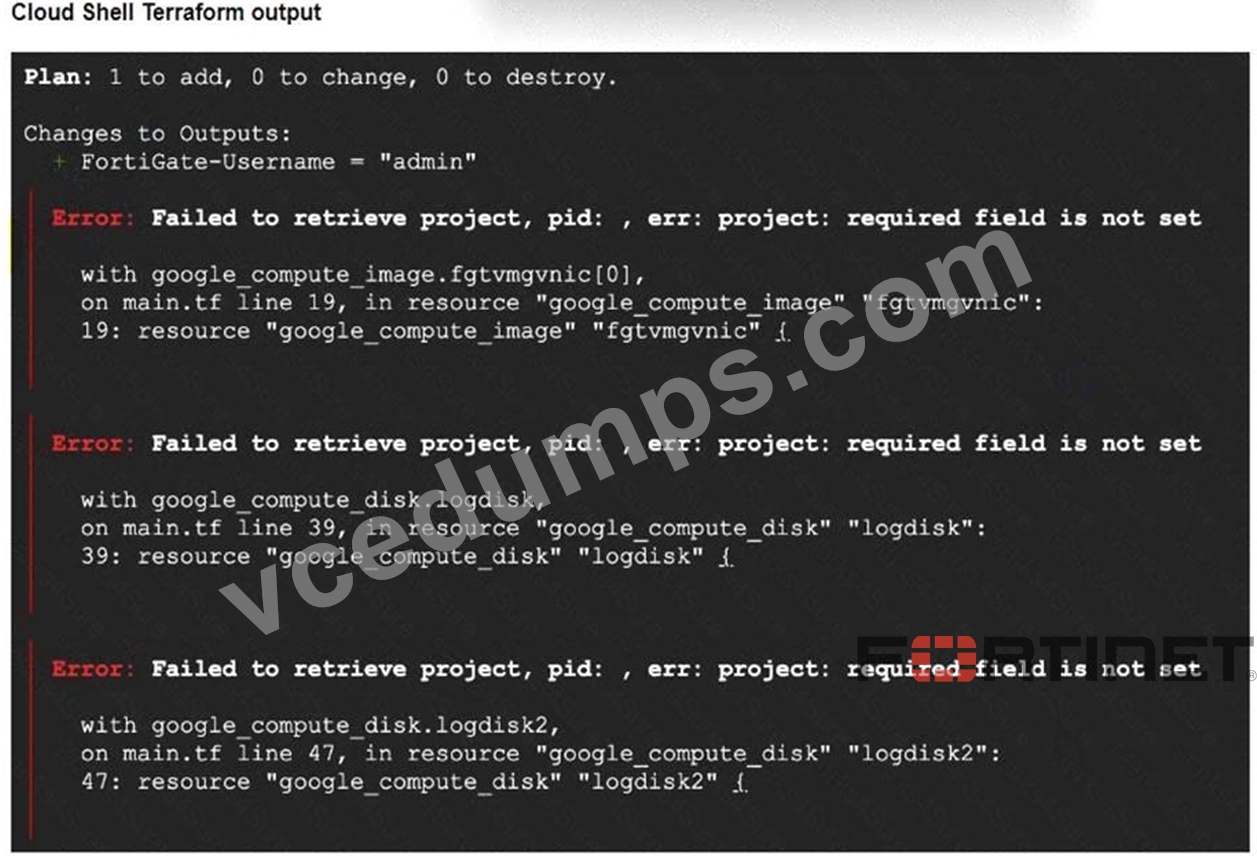
An administrator is attempting to deploy a Terraform template using Google Cloud Shell.
Which step must the administrator take to solve the error?
- A. Delete the admin user to proceed with the Terraform script.
- B. Use the command gcloud config set project to set the Google Cloud project in Google Cloud Shell.
- C. Manually create a Google Cloud storage bucket for logging functionality.
- D. Use the command terraform init to initialize the Terraform directory.
Answer: B
Explanation:
The error indicates the Google Cloud project is not set, which is required for Terraform to access resources.
Setting the project with gcloud config set project [PROJECT_ID] resolves this by specifying the active project in Cloud Shell.
NEW QUESTION # 27
An organization is deploying an active-passive high availability (HA) cluster using passthrough load balancers in Google Cloud.
What is a critical factor for ensuring successful HA formation, failover, and traffic flow?
- A. Incoming traffic must be source NATed to ensure traffic flow symmetry.
- B. Unicast FortiGate Clustering Protocol (FGCP) must be used.
- C. There can be more than two cluster members.
- D. VDOM exceptions must be configured.
Answer: A
Explanation:
Source NAT ensures that traffic is symmetric by keeping the source IP consistent, which is critical for proper failover and session synchronization in an active-passive HA cluster using passthrough load balancers.
NEW QUESTION # 28
An administrator has been tasked with modifying their organization's existing active-passive high-availability (HA) FortiGate cluster and turn it into an active-active HA cluster.
Which two behavior changes will the administrator see in the cluster after the change? (Choose two.)
- A. The sessions will no longer be synchronized between cluster members.
- B. There is no longer a need to reserve a dedicated port for HA communications.
- C. The configuration will no longer be synchronized between cluster members.
- D. The cluster no longer act as a single logical instance.
Answer: B,D
Explanation:
Active-active HA does not require a dedicated HA communication port as each member handles traffic independently.
In active-active mode, cluster members operate more independently and do not present as a single logical device like in active-passive mode.
NEW QUESTION # 29
An organization decided to decommission a deployed FortiWeb instance on Google Cloud.
What is the most efficient way to delete the FortiWeb instance and all of its dependent resources?
- A. Visit Google Cloud Marketplace and unsubscribe from FortiWeb pay-as-you-go.
- B. Delete the FortiWeb instance manually in the Compute Engine portal.
- C. Use Google Cloud Deployment Manager to delete the FortiWeb deployment.
- D. Use Google Cloud Solutions to delete the FortiWeb deployment.
Answer: C
Explanation:
Google Cloud Deployment Manager manages the lifecycle of deployments and their dependent resources, enabling efficient and clean deletion of FortiWeb instances and all associated resources in one operation.
NEW QUESTION # 30
You have been tasked with deploying an active-active FortiGate high-availability cluster in Google Cloud.
How can you ensure that traffic will flow symmetrically?
- A. Enable the layer 3 unified threat management scanning feature on FortiGate.
- B. Deploy internal passthrough network load balancers on both sides of the cluster they support symmetric hashing.
- C. Google Cloud performs NAT on incoming traffic for external passthrough network load balancers. No action is needed.
- D. There is no need to ensure traffic symmetry because FortiGate can effectively inspect asymmetric traffic.
Answer: B
NEW QUESTION # 31
Refer to the exhibit.
Which two types of traffic flow must the FortiGate cluster inspect, if the client at 198.51.100.10 sends traffic to the Workload A instance? (Choose two.)
- A. West-bound
- B. South-bound
- C. East-bound
- D. North-bound
Answer: B,C
Explanation:
South-bound traffic refers to traffic coming from outside the network (the client 198.51.100.10) into the internal environment.
East-bound traffic refers to traffic moving laterally within the internal network, such as between VPCs or workloads, which the FortiGate cluster can inspect for internal threats.
NEW QUESTION # 32
Refer to the exhibit.
An administrator is troubleshooting network connectivity issues between two VMs deployed in Google Cloud.
One VM is a FortiGate located in the subnet "wan" that is part of the VPC "e-commerce". The other VM is a Windows server located in subnet "servers", which is also in the "e-commerce" VPC.
What are two reasons you cannot pint the Windows server from FortiGate? (Choose two.)
- A. The default Google Cloud firewall policy does not allow this traffic.
- B. Add a Google Cloud firewall rule to allow ICMP traffic inbound to the Windows firewall VM.
- C. ICMP traffic is blocked between Google Cloud subnets by default.
- D. The Windows firewall is blocking the traffic.
Answer: B,D
Explanation:
Google Cloud firewall rules are stateful and, by default, do not allow ICMP traffic; you must explicitly allow ICMP inbound traffic to the Windows VM.
The Windows VM's own firewall might block ICMP traffic, preventing ping responses.
NEW QUESTION # 33
An administrator wants to use the FortiGate automation stitch feature to quarantine compromised hosts.
Which native Google Cloud service should the administrator integrate with FortiGate to achieve this?
- A. Google Cloud Run functions
- B. Google Cloud App_ Engine
- C. Google Cloud IAM
- D. Google Cloud Interconnect
Answer: A
Explanation:
Google Cloud Run allows you to run serverless containerized functions that can be triggered by FortiGate automation stitches to perform actions such as quarantining compromised hosts. It is the native service best suited for automating responses in cloud environments.
NEW QUESTION # 34
You have been tasked with destroying all resources relating to a recent active-active high-availability (HA) FGSP Terraform deployment in Google Cloud.
What steps do you have to take to ensure a successful deletion? (Choose two.)
- A. Delete all dependencies to resources relating to the Terraform template.
- B. Delete all resources manually because active-active HA clusters cannot be destroyed using Terraform.
- C. Use the command terraform plan before destroying the Terraform template.
- D. Use the command terraform destroy to delete all resources deployed by the Terraform template.
Answer: A,D
Explanation:
Removing dependencies prevents resource conflicts during deletion.
terraform destroy is the correct command to cleanly and completely remove all resources created by the Terraform deployment.
NEW QUESTION # 35
Your organization is deciding between deploying FortiGate active-passive high-availability (HA) in Google Cloud using either the software-defined network (SDN) connector or load balancers.
What two reasons should your organization choose the SDN connector over the load balancer deployment?
(Choose two.)
- A. Cost is lower.
- B. The SDN connector supports multizone failover.
- C. There isess administrative overhead.
- D. Failovers are faster because of to API calls.
Answer: A,C
Explanation:
Using the SDN connector avoids additional load balancer costs, making it more cost-effective.
The SDN connector enables multizone failover by directly managing network routing, which load balancers do not inherently support.
NEW QUESTION # 36
......
FCP_GCS_AD-7.6 PDF Dumps Are Helpful To produce Your Dreams Correct QA's: https://testinsides.vcedumps.com/FCP_GCS_AD-7.6-examcollection.html
