

Download Latest SOA-C02 Dumps with Authentic Real Exam Questions
Authentic SOA-C02 Exam Dumps PDF - Jan-2026 Updated
Amazon SOA-C02 exam is an important step towards becoming an AWS Certified SysOps Administrator at the associate level. SOA-C02 exam tests an individual's knowledge of AWS services and their ability to use them to build, deploy and manage highly available and scalable systems. Candidates should have a strong understanding of AWS services and their use cases and should have experience in deploying, managing, and operating highly available and scalable systems on AWS. AWS offers a variety of training and certification courses that can help candidates prepare for the exam.
NEW QUESTION # 224
A SysOps administrator is responsible for more than 50 Amazon EC2 instances mat are deployed in a single production AWS account The EC2 instances are running several different operating systems The company's standards require patching to be completed at least once a month.
The SysOps administrator wants to use AWS Systems Manager to reduce the number of hours the company spends on operating system patching each month.
Which combination of steps should the SysOps administrator take to meet these requirements? (Select THREE.)
- A. Specify Systems Manager Automation runbooks to patch the operating systems. Register the runbooks as tasks in the maintenance window. Specify the appropriate resource group as the target
- B. Create a single Systems Manager maintenance window for each resource group.
- C. Create a schedule in Systems Manager Patch Manager. Specify the appropriate resource group as the target
- D. Create a Systems Manager Automation runbook to monitor and control the state of the patches required. Apply the runbook to Systems Manager Patch Manager
- E. Configure Systems Manager Fleet Manager to apply a Systems Manager Automation runbook to the appropriate resource group.
- F. Group similar EC2 instances together into resource groups by using AWS Resource Groups
Answer: B,C,F
Explanation:
* Group EC2 Instances Using Resource Groups:
Resource groups help organize and manage AWS resources based on tags and other criteria.
Steps:
Go to the AWS Management Console.
Navigate to AWS Resource Groups.
Create resource groups for similar EC2 instances based on tags or other criteria.
Reference:
* Create a Schedule in Patch Manager:
AWS Systems Manager Patch Manager automates the process of patching managed instances.
Steps:
Go to the AWS Management Console.
Navigate to Systems Manager and select Patch Manager.
Create a patch baseline if not already created.
Create a schedule for patching and specify the resource group as the target.
* Create Maintenance Windows for Resource Groups:
Maintenance windows define a period of time for performing administrative tasks on instances.
Steps:
Go to the AWS Management Console.
Navigate to Systems Manager and select Maintenance Windows.
Create a maintenance window for each resource group.
Specify tasks and targets (resource groups) for each maintenance window.
NEW QUESTION # 225
A gaming application is deployed on four Amazon EC2 instances in a default VPC. The SysOps administrator has noticed consistently high latency in responses as data is transferred among the four instances. There is no way for the administrator to alter the application code. The MOST effective way to reduce latency is to relaunch the EC2 instances in:
- A. a single Availability Zone.
- B. a single subnet inside the VPC.
- C. a placement group.
- D. a dedicated VPC.
Answer: C
NEW QUESTION # 226
A company has an application that is deployed 10 two AWS Regions in an active-passive configuration. The application runs on Amazon EC2 instances behind an Application Load Balancer (ALB) in each Region. The instances are in an Amazon EC2 Auto Scaling group in each Region. The application uses an Amazon Route
53 hosted zone (or DNS. A SysOps administrator needs to configure automatic failover to the secondary Region.
What should the SysOps administrator do to meet these requirements?
- A. Configure Elastic Load Balancing (ELB) health checks for the Auto Scaling group. Add a target group to the ALB in the primary Region. Include the EC2 instances in the secondary Region as targets.
- B. Configure Route 53 alias records that point to each ALB. Choose a failover routing policy. Set Evaluate Target Health to Yes.
- C. Configure EC2 health checks for the Auto Scaling group. Add a target group to the ALB in the primary Region. Include the EC2 instances in the secondary Region as targets.
- D. Configure CNAME records that point to each ALB. Choose a failover routing policy. Set Evaluate Target Health to Yes.
Answer: B
NEW QUESTION # 227
A new website will run on Amazon EC2 instances behind an Application Load Balancer. Amazon Route 53 will be used to manage DNS records.
What type of record should be set in Route 53 to point the website's apex domain name (for example.company.com to the Application Load Balancer?
- A. TXT
- B. CNAME
- C. ALIAS
- D. SOA
Answer: C
Explanation:
When using Amazon Route 53 to manage DNS records for a website hosted behind an Application Load Balancer (ALB), an ALIAS record should be used for the apex domain (e.g., example.com). ALIAS records are designed to map domain names to AWS resources like ALBs, CloudFront distributions, and S3 buckets, providing efficient DNS resolution.
* Login to AWS Management Console:
* Open the Route 53 console at Amazon Route 53 Console.
* Select Hosted Zone:
* Select the hosted zone for your domain.
* Create Record Set:
* Click on Create record.
* In the Record name field, leave it blank to indicate the apex domain.
* Select ALIAS as the record type.
* Choose the Alias Target to be your Application Load Balancer from the dropdown menu.
* Save Record Set:
* Review the settings and click Create records.
References:
* Choosing Between Alias and Non-Alias Records
* Routing Traffic to an ELB Load Balancer
NEW QUESTION # 228
A software company runs a workload on Amazon EC2 instances behind an Application Load Balancer (ALB) A SysOcs administrator needs to define a custom health check for the EC2 instances. What is the MOST operationally efficient solution?
- A. Set up each EC2 Instance so that it writes its healthy/unhealthy status into a shared Amazon S3 bucket for the ALB to read
- B. Configure the health check on the ALB and ensure that the HeathCheckPath setting is correct
- C. Set up Amazon ElasticCache to track the EC2 instances as they scale in and out
- D. Configure an Amazon API Gateway health check to ensure custom checks on aw of the EC2 instances
Answer: B
NEW QUESTION # 229
A company currently runs its infrastructure within a VPC in a single Availability Zone The VPC is connected to the company's on-premises data center through an AWS Site-to-SIte VPN connection attached to a virtual pnvate gateway. The on-premises route tables route all VPC networks to the VPN connection Communication between the two environments is working correctly. A SysOps administrator created new VPC subnets within a new Availability Zone, and deployed new resources within the subnets. However, communication cannot be established between the new resources and the on-premises environment.
Which steps should the SysOps administrator take to resolve the issue?
- A. Add a route to the route tables of the new subnets that send on-premises traffic to the virtual private gateway.
- B. Establish a new Site-to-Site VPN connection between a virtual private gateway attached to the new Availability Zone and the on-premises data center
- C. Replace the Site-to-Site VPN connection with an AWS Direct Connect connection.
- D. Create a ticket with AWS Support to request adding Availability Zones to the Site-to-Site VPN route configuration.
Answer: A
Explanation:
Adding a Route to the Route Tables:
* When new subnets are created, they need appropriate routing to ensure communication with on-premises networks.
* Steps:
* Go to the AWS Management Console.
* Navigate to VPC.
* Select the route table associated with the new subnets.
* Choose "Edit routes."
* Add a new route with the destination CIDR block of the on-premises network.
* For the target, select the virtual private gateway (VGW).
* This ensures that traffic destined for the on-premises network is routed correctly through the VPN connection.
* AWS VPC Route Tables
NEW QUESTION # 230
A company plans to launch a static website on its domain example com and subdomain www example.com using Amazon S3. How should the SysOps administrator meet this requirement?
- A. Create two S3 buckets named http//example.com and http//" exampte.com. Configure the wildcard (') bucket to redirect requests to the domain bucket.
- B. Create two S3 buckets named example.com and www.exdmpte.com. Configure the subdomain bucket to redirect requests to the domain bucket.
- C. Create one S3 bucket named example.com for both the domain and subdomain.
- D. Create one S3 bucket with a wildcard named '.example.com tor both the domain and subdomain.
Answer: B
Explanation:
To host a static website using Amazon S3 for both a domain and its subdomain, you need to create two separate buckets and configure one bucket to redirect to the other.
Steps:
Create the Main Domain Bucket:
Open the Amazon S3 console.
Create a bucket named example.com.
Enable static website hosting for the bucket and configure the index document (e.g., index.html).
Create the Subdomain Bucket:
Create another bucket named www.example.com.
In the bucket properties, enable static website hosting.
Set the website hosting configuration to redirect all requests to example.com.
Update DNS Configuration:
Open the Amazon Route 53 console.
Create an A record for example.com and www.example.com pointing to the S3 bucket.
Reference:
Hosting a Static Website on Amazon S3
Configuring a Static Website Using a Custom Domain
NEW QUESTION # 231
A company has many accounts in an organization in AWS Organizations The company must automate resource provisioning from the organization's management account to the member accounts.
Which solution will meet this requirement?
- A. Create an AWS CkHJdFormation change set Deploy the change set to all member accounts
- B. Create an AWS CtoudFormation nested stack Deploy the nested stack to all member accounts.
- C. Create an AWS Serverless Application Model (AWS SAM) template. Deploy the template to all member accounts.
- D. Create an AWS CtoudFormation stack set Deploy the stack set to all member accounts.
Answer: D
Explanation:
Using CloudFormation Stack Sets:
CloudFormation stack sets allow you to deploy CloudFormation stacks across multiple AWS accounts and regions.
Steps:
Go to the AWS Management Console.
Navigate to CloudFormation and select "StackSets."
Click on "Create StackSet."
Provide the template URL or upload a template file.
Configure the stack set options and specify the accounts and regions.
Deploy the stack set to the specified accounts and regions.
NEW QUESTION # 232
Lab Simulation 1
If your AWS Management Console browser does not show that you are logged in to an AWS account, close the browser and relaunch the console by using the AWS Management Console shortcut from the VM desktop.
If the copy-paste functionality is not working in your environment, refer to the instructions file on the VM desktop and use Ctrl+C, Ctrl+V or Command-C , Command-V.
Configure Amazon EventBridge to meet the following requirements.
1. Use the us-east-2 Region for all resources.
2. Unless specified below, use the default configuration settings.
3. Use your own resource naming unless a resource name is specified below.
4. Ensure all Amazon EC2 events in the default event bus are replayable for the past 90 days.
5. Create a rule named RunFunction to send the exact message every 15 minutes to an existing AWS Lambda function named LogEventFunction.
6. Create a rule named SpotWarning to send a notification to a new standard Amazon SNS topic named TopicEvents whenever an Amazon EC2 Spot Instance is interrupted. Do NOT create any topic subscriptions. The notification must match the following structure:
Input template:
'The EC2 Spot Instance <instance> has been on account.'Important: Click the Next button to complete this lab and continue to the next lab. Once you click the Next button, you will NOT be able to return to this lab.
Answer:
Explanation:


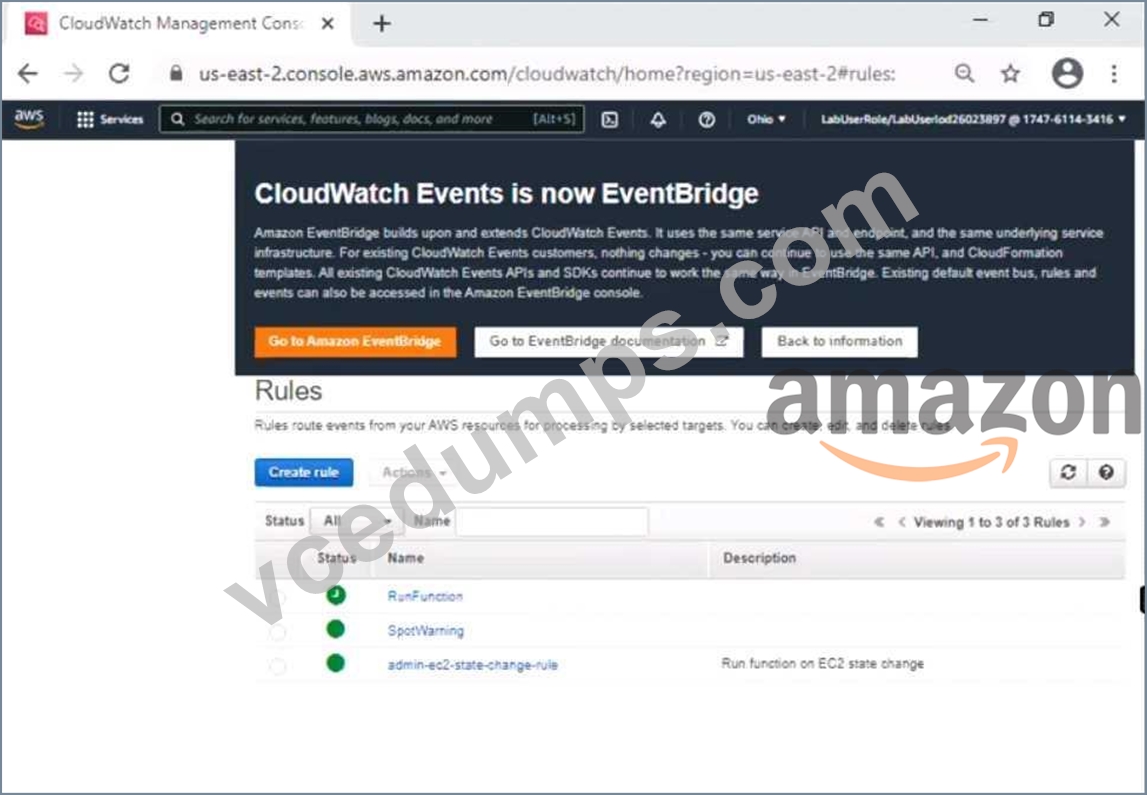
NEW QUESTION # 233
A company has several business units that want to use Amazon EC2. The company wants to require all business units to provision their EC2 instances by using only approved EC2 instance configurations.
What should a SysOps administrator do to implement this requirement?
- A. Share an AWS CloudFormation template with the business units. Instruct the business units to pass a role to AWS CloudFormation to allow the service to manage EC2 instances.
- B. Develop an IAM policy that limits the business units to provision EC2 instances only. Instruct the business units to launch instances by using an AWS CloudFormation template.
- C. Publish a product and launch constraint role for EC2 instances by using AWS Service Catalog. Allow the business units to perform actions in AWS Service Catalog only.
- D. Create an EC2 instance launch configuration. Allow the business units to launch EC2 instances by specifying this launch configuration in the AWS Management Console.
Answer: C
Explanation:
To enforce the use of approved EC2 instance configurations across different business units efficiently:
* AWS Service Catalog: Utilize AWS Service Catalog to manage and govern commonly deployed IT
* services. Create a catalog of pre-approved products (in this case, EC2 instance configurations).
* Publish Products: Define and publish EC2 instance configurations as products within the Service Catalog. These products will incorporate all the necessary and approved configurations, options, and software.
* Launch Constraints: Assign launch constraints to these products, ensuring that users can only launch EC2 instances as defined by the pre-approved configurations.
* Control Access: Grant business units access only to the Service Catalog for provisioning EC2 instances.
This ensures they use only those configurations that comply with company policies and standards.
This approach not only standardizes resource deployment but also simplifies management and enhances compliance across the organization.
NEW QUESTION # 234
A compliance team requires all administrator passwords tor Amazon RDS DB instances to be changed at toast annually Which solution meets this requirement in the MOST operationally efficient manned
- A. Store the database credentials in AWS Secrets Manager Configure automate rotation for the secret every 365 days
- B. Store the database credentials in a private Amazon S3 bucket Schedule an AWS Lambda function to generate a new set of credentials every 365 days
- C. Store the database credentials in AWS Systems Manager Parameter Store as a secure string parameter Configure automatic rotation for the parameter every 365 days
- D. Store the database credentials as a parameter in the RDS parameter group Create a database trigger to rotate the password every 365 days
Answer: A
NEW QUESTION # 235
A SysOps administrator has an AWS CloudFormation template of the company's existing infrastructure in us-west-2. The administrator attempts to use the template to launch a new stack in eu-west-1, but the stack only partially deploys, receives an error message, and then rolls back.
Why would this template fail to deploy? (Select TWO.)
- A. The template referenced an Amazon Machine Image (AMI) that is not available in eu-west-1.
- B. The template requested services that do not exist in eu-west-1.
- C. The template did not have the proper level of permissions to deploy the resources.
- D. CloudFormation templates can be used only to update existing services.
- E. The template referenced an IAM user that is not available in eu-west-1.
Answer: A,B
NEW QUESTION # 236
A company is running Amazon EC2 On-Demand Instances in an Auto Scaling group. The instances process messages from an Amazon Simple Queue Service (Amazon SQS) queue. The Auto Scaling group is set to scale based on the number of messages in the queue. Messages can take up to 12 hours to process completely.
A SysOps administrator must ensure that instances are not interrupted during message processing.
What should the SysOps administrator do to meet these requirements?
- A. Set the Auto Scaling group's termination policy to OldestLaunchConfiguration.
- B. Enable instance scale-in protection for the specific instance in the Auto Scaling group at the start of message processing by calling the Amazon EC2 Auto Scaling API from the processing script. Disable instance scale-in protection after message processing is complete by calling the Amazon EC2 Auto Scaling API from the processing script.
- C. Set the Auto Scaling group's termination policy to OldestInstance.
- D. Suspend the Launch and Terminate scaling processes for the specific instance in the Auto Scaling group at the start of message processing by calling the Amazon EC2 Auto Scaling API from the processing script. Resume the scaling processes after message processing is complete by calling the Amazon EC2 Auto Scaling API from the processing script.
Answer: B
Explanation:
# Enable instance scale-in protection for specific instance.
aws autoscaling set-instance-protection --instance-ids i-5f2e8a0d --auto-scaling-group-name my-asg
--protected-from-scale-in
# Disable instance scale-in protection for the specified instance.
aws autoscaling set-instance-protection --instance-ids i-5f2e8a0d --auto-scaling-group-name my-asg
--no-protected-from-scale-in
https://docs.aws.amazon.com/autoscaling/ec2/userguide/ec2-auto-scaling-instance-protection.html To ensure that EC2 instances in an Auto Scaling group are not interrupted during message processing, the most effective method is to implement scale-in protection for the instances while they are actively processing messages. This can be done programmatically by modifying the Auto Scaling group's settings using the Amazon EC2 Auto Scaling API.
* Starting Message Processing: When an instance begins processing a message, your application should make an API call to enable scale-in protection. This is done using the SetInstanceProtection action, setting the ProtectedFromScaleIn parameter to true for that specific instance.
* Completing Message Processing: Once the message has been processed, another API call should be made to disable scale-in protection. This is done by calling the SetInstanceProtection action again, but this time setting the ProtectedFromScaleIn parameter to false.
This method ensures that while messages are being processed, the instances are not terminated by the Auto Scaling group regardless of any scale-in activities that might be triggered by other parameters like CPU utilization or a decrease in the number of messages in the queue.
AWS Documentation Reference:You can refer to the AWS documentation on managing instance scale-in protection in Auto Scaling groups for more details: Instance Scale-In Protection.
NEW QUESTION # 237
A company is using an Amazon DynamoDB table for data.
A SysOps administrator must configure replication of the table to another AWS Region for disaster recovery.
What should the SysOps administrator do to meet this requirement?
- A. Enable DynamoDB Accelerator (DAX).
- B. Enable DynamoDB Streams, and add a global secondary index (GSI).
- C. Enable point-in-time recovery.
- D. Enable DynamoDB Streams, and-add a global table Region.
Answer: D
NEW QUESTION # 238
A company uses AWS Organizations to manage multiple AWS accounts with consolidated billing enabled. Organization member account owners want the benefits of Reserved Instances (RIs) but do not want to share RIs with other accounts.
Which solution will meet these requirements?
- A. Purchase RIs in the management account. Disable Rl discount sharing in the management account.
- B. Purchase RIs in individual member accounts. Disable Rl discount sharing in the management account.
- C. Purchase RIs in the management account. Disable Rl discount sharing in the member accounts.
- D. Purchase RIs in individual member accounts. Disable Rl discount sharing in the member accounts.
Answer: B
Explanation:
https://aws.amazon.com/premiumsupport/knowledge-center/ec2-ri-consolidated-billing/ RI discounts apply to accounts in an organization's consolidated billing family depending upon whether RI sharing is turned on or off for the accounts. By default, RI sharing for all accounts in an organization is turned on. The management account of an organization can change this setting by turning off RI sharing for an account. The capacity reservation for an RI applies only to the account the RI was purchased on, no matter whether RI sharing is turned on or off.
NEW QUESTION # 239
A SysOps administrator creates a new source AWS account to use with a company's new application. The application will use Amazon CloudWatch for observability from a monitoring account. The company already used an AWS CloudFormation template to turn on CloudWatch cross-account observability for its other application accounts.
Which combination of steps must the SysOps administrator take to set up the new source account for cross- account observability? (Select THREE.)
- A. Download the CloudFormation template from the new source account.
- B. Add the new source account ID to the monitoring account's configuration policy.
- C. Deploy the CloudFormation stack in the monitoring account.
- D. In the new source account, specify the data that the monitoring account will be able to view.
- E. Download the CloudFormation template from the monitoring account.
- F. Deploy the CloudFormation stack in the new source account.
Answer: B,D,F
Explanation:
AWS CloudWatch cross-account observability allows a central monitoring account to access logs, metrics, and traces from source accounts.
From the Amazon CloudWatch cross-account observability setup guide:
To set up a new source account, you must:
Deploy the CloudFormation template provided by AWS in the source account to configure resource sharing and access.# # C Add the new source account ID to the monitoring account configuration so the monitoring account knows which accounts to observe.# # E In the source account, configure what data types (logs, metrics, traces) will be shared with the monitoring account.# # F
# Why the other options are incorrect:
A/B: You do not download the template from the accounts themselves. AWS provides a template, or your organization reuses an existing one.
D: The template must be deployed in the source account, not the monitoring account.
NEW QUESTION # 240
......
SOA-C02 Dumps for success in Actual Exam: https://testinsides.vcedumps.com/SOA-C02-examcollection.html
