

(2025) PASS FCSS_ADA_AR-6.7 exam with Fortinet FCSS_ADA_AR-6.7 Real Exam Questions
Real exam questions are provided for FCSS in Security Operations tests, which can make sure you 100% pass
Fortinet FCSS_ADA_AR-6.7 Exam Syllabus Topics:
| Topic | Details |
|---|---|
| Topic 1 |
|
| Topic 2 |
|
| Topic 3 |
|
| Topic 4 |
|
NEW QUESTION # 14
What is the estimated time that it would take for the collector to reach the maximum buffer size for a
2000 EPS license?
- A. 55.55 hours
- B. 13.88 hours
- C. 9.25 hours
- D. 27.77 hours
Answer: B
NEW QUESTION # 15
Refer to the exhibit.
The rule evaluates multiple VPN logon failures within a ten-minute window.
Consider the following VPN failure events received within a ten-minute window:
How many incidents are generated?
- A. 0
- B. 1
- C. 2
- D. 3
Answer: D
NEW QUESTION # 16
What will be the correct data type for inner query?
- A. INT16
- B. IP
- C. STRING
- D. INT32
Answer: B
NEW QUESTION # 17
Refer to the exhibit.
If the Z-score for this rule is greater than or equal to three, what does this mean?
- A. The rate of firewall connection is below historical average value.
- B. The rate firewall connection is above the historical average value.
- C. The rate of firewall connection is above the current average value.
- D. The rate of firewall connection is optimum.
Answer: B
Explanation:
The Z-score formula in the expression builder calculates how many standard deviations the current value is from the historical average. The formula used is:
AVG(Firewall Session) represents the current firewall session rate.
STAT_AVG(AVG(Firewall Session);112) represents the historical average over a 112-time unit window.
STAT_STDDEV(AVG(Firewall Session);112) represents the historical standard deviation over the same period.
A Z-score ≥ 3 indicates that the current firewall session rate is significantly higher than the historical average (3 standard deviations above the mean), signaling an anomaly.
NEW QUESTION # 18
Refer to the exhibit.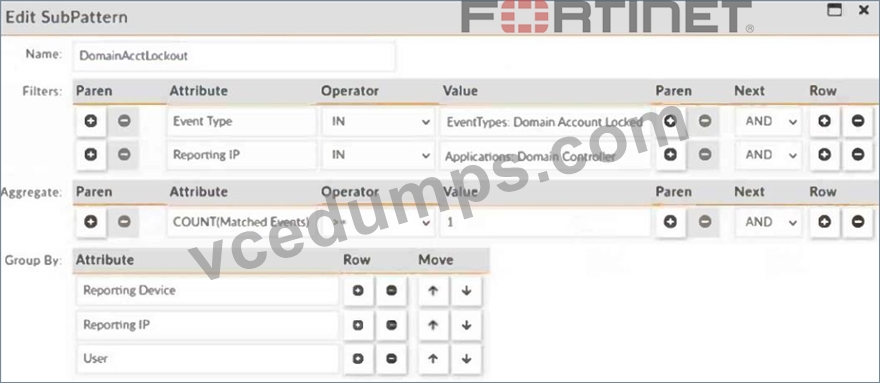
Consider the five account locked events received by FortiSIEM from domain controllers within the last 10 minutes (ten minutes is the evaluation window for the subpattern DomainAcctLockout):
If you look for one or more matching events and groupings by the same reporting IP address, reporting device, and user, how many incidents are created?
- A. 0
- B. 1
- C. 2
- D. 3
Answer: A
Explanation:
The rule groups events by Reporting IP, Reporting Device, and User. Let's analyze the five events:
Events Received:
1. Reporting IP: 1.1.1.1, Reporting Device: Server101, User: John
2. Reporting IP: 1.1.1.1, Reporting Device: Server101, User: Craig
3. Reporting IP: 1.1.1.2, Reporting Device: Server109, User: Mary
4. Reporting IP: 1.1.1.1, Reporting Device: Server101, User: Craig (Duplicate of #2)
5. Reporting IP: 1.1.1.1, Reporting Device: Server101, User: John (Duplicate of #1) Grouping Based on:
*Reporting IP
*Reporting Device
*User
Count unique groups:
1. (1.1.1.1, Server101, John) → 2 occurrences (counted as one group)
2. (1.1.1.1, Server101, Craig) → 2 occurrences (counted as one group)
3. (1.1.1.2, Server109, Mary) → 1 occurrence (counted as one group)
Since we need at least one matching event (count >= 1) per group, incidents are created for each unique group.
Total unique groups (incidents created) = 2
*John on Server101 (1.1.1.1)
*Craig on Server101 (1.1.1.1)
NEW QUESTION # 19
Refer to the exhibit.
Which scenario is not a supported nested query scenario?
- A. The outer query is the CMDB query, and the inner query is the CMDB query.
- B. The outer query is the event query, and the inner query is the CMDB query.
- C. The outer query is the CMDB query, and the inner query is the event query.
- D. The outer query is the event query, and the inner query is the event query.
Answer: A
Explanation:
FortiSIEM does not allow CMDB queries to be nested within other CMDB queries. CMDB data is static information, and nesting would not add value or function properly in query execution.
NEW QUESTION # 20
Refer to the exhibit.
An administrator runs an analytic search for all FortiGate SSL VPN logon failures. The results are grouped by source IP, reporting IP, and user. The administrator wants to restrict the results to only those rows where the COUNT >=3.
Which user would meet that condition?
- A. Admin
- B. Jan
- C. Sarah
- D. Tom
Answer: A
Explanation:
The administrator is running an analytic search that groups results bySource IP, Reporting IP, and User, and filters only those with aCOUNT >= 3.
Looking at the data:
#Adminhas three failed attempts from thesame Source IP (203.0.113.4)andReporting IP (10.0.1.99).
#JanandSarahappear onlyonce or twicein the dataset.
#Tomhasmultiple entries, but they are fromdifferent Source IPs and Reporting IPs, meaning they are not counted as three under the same group.
NEW QUESTION # 21
Refer to the exhibit.
Why is the windows device still in the CMDB, even though the administrator uninstalled the windows agent?
- A. The device has performance jobs assigned
- B. The device was not installed properly
- C. The device must be deleted from backend of FortiSIEM
- D. The device must be deleted manually from the CMDB
Answer: C
NEW QUESTION # 22
Refer to the exhibit.
An administrator runs an analytic search for all FortiGate SSL VPN logon failures. The results are grouped by source IP, reporting IP, and user. The administrator wants to restrict the results to only those rows where the COUNT >=3.
Which user would meet that condition?
- A. Jan
- B. Sarah
- C. Tom
- D. Admin
Answer: C
NEW QUESTION # 23
A service provider purchased a licensed EPS of 520 and the total unused events is 72,000. Calculate the total amount of allowed events for the next 3-minute interval.
- A. 192,442
- B. 192,456
- C. 192,450
- D. 192,446
Answer: B
NEW QUESTION # 24
Refer to the exhibit.
Based on the information provided in the exhibit, calculate the unused events for the next three minutes for a 520 EPS license.
- A. 0
- B. 1
- C. 2
- D. 3
Answer: B
NEW QUESTION # 25
During which time period is the license enforcement performed on the number of events received?
- A. Events received every minute
- B. Events received every two minutes
- C. Events received every second
- D. Events received every three minutes
Answer: D
NEW QUESTION # 26
Refer to the exhibit.
If the Z-score for this rule is greater than or equal to three, what does this mean?
- A. The rate of firewall connection is below historical average value.
- B. The rate firewall connection is above the historical average value.
- C. The rate of firewall connection is above the current average value.
- D. The rate of firewall connection is optimum.
Answer: B
Explanation:
The Z-score formula in the expression builder calculates how many standard deviations the current value is from the historical average. The formula used is:
AVG(Firewall Session)represents the current firewall session rate.
STAT_AVG(AVG(Firewall Session);112)represents the historical average over a 112-time unit window.
STAT_STDDEV(AVG(Firewall Session);112)represents the historical standard deviation over the same period.
AZ-score # 3indicates that the current firewall session rate issignificantly higherthan the historical average (3 standard deviations above the mean), signaling ananomaly.
NEW QUESTION # 27
Which two statements about the maximum device limit on FortiSIEM are true? (Choose two.)
- A. The device limit is defined per customer and every customer is assigned a fixed number of device limit by the service provider.
- B. The device limit is based on the license type that was purchased from Fortinet.
- C. The device limit is defined for the whole system and is shared by every customer on a service provider edition.
- D. The device limit is only applicable to enterprise edition.
Answer: A,B
NEW QUESTION # 28
FortiSIEM's UEBA capabilities primarily focus on:
- A. Monitoring and analyzing behavior patterns to identify potential risks?
- B. Providing encryption algorithms for data transfers?
- C. Streamlining the software update process?
- D. Ensuring all users have similar access privileges?
Answer: A
NEW QUESTION # 29
Refer to the exhibit.
The exhibit shows the output of an SQL command that an administrator ran to view the natural_id value, after logging into the Postgres database.
What does the natural_id value identify?
- A. The supervisor
- B. The collector
- C. An agent
- D. The worker
Answer: B
Explanation:
Thenatural_idvalue in theph_sys_connectortable of theFortiSIEM Postgres databaseuniquely identifies acollector.
# The SQL query retrieves details fromph_sys_connector, which stores information about registered collectors.
# Thecust_org_idfield indicates theorganization IDthe collector belongs to.
# Thenamefield shows thecollector's name(OrgA_Collector).
# Theip_addrfield lists thecollector's IP address(10.10.2.91).
# Thenatural_idvalue uniquelyidentifies the collector in the system.
NEW QUESTION # 30
......
Latest FCSS_ADA_AR-6.7 Pass Guaranteed Exam Dumps Certification Sample Questions: https://testinsides.vcedumps.com/FCSS_ADA_AR-6.7-examcollection.html
