

Best Quality dbt Labs dbt-Analytics-Engineering Exam Questions VCEDumps Realistic Practice Exams [2026]
Critical Information To dbt Analytics Engineering Certification Exam Pass the First Time
NEW QUESTION # 19
You have created a model called stg_tasks and now you need to implement tests.
You provide this in schema.yml:
version: 2
models:
- name: stg_tasks
columns:
- name: completed_at
tests:
- not_null:
- config:
where: "state = 'completed'"
You receive this compilation error:
[WARNING]: Did not find matching node for patch with name 'stg_tasks' in the 'models' section of file
'models/example/schema.yml'
How can you change the configuration on the not_null test to fix this compiler error?
- A. tests:
- not_null:
- config:
where: "state = 'completed'" - B. tests:
- not_null:
- config:
where: "state = 'completed'"
Choose 1 option. - C. tests:
- not_null:
config:
where: "state = 'completed'" - D. tests:
- not_null:
config:
where: "state = 'completed'"
Answer: C
Explanation:
In dbt, when you configure a generic test like not_null in YAML, the configuration for that test must be a mapping, not another list item. The correct structure is:
tests:
- not_null:
config:
where: "state = 'completed'"
In your original YAML, you wrote:
tests:
- not_null:
- config:
where: "state = 'completed'"
The extra dash (- config) makes config an element of a list rather than a key under the not_null test. This breaks the expected shape of the test definition. When dbt parses the schema.yml, it fails to correctly interpret the patch for the stg_tasks model, which leads to the warning: "Did not find matching node for patch with name 'stg_tasks'...".
By removing the extra dash and nesting config directly under not_null, dbt now reads this as a single generic test named not_null with a config block that passes the where argument. This allows dbt to correctly attach the test to the completed_at column of the stg_tasks model and eliminates the compiler warning.
Therefore, Option B is the only structurally valid configuration and is the correct answer.
NEW QUESTION # 20
A common dimension table is used in 80% of your models. What might be a side effect of frequently changing the structure of this dimension?
- A. You might need to update a large number of downstream models.
- B. It would cause errors in models that are not directly dependent on this dimension.
- C. Compile times would significantly increase across the project.
- D. The dbt docs output would become unmanageable.
Answer: A
Explanation:
Changing core dimensions has ripple effects on dependent models. While docs could become more complex, the primary issue is maintaining those dependencies.
NEW QUESTION # 21
31. Your entire DAG looks like the image shown.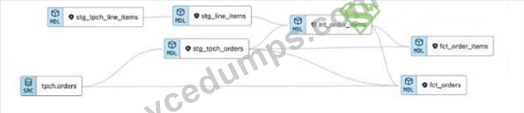
(Several stg_ models appear upstream, feeding into int_ and fct_ models.) The question asks:
"Was this modeling rule violated?
Staging models dependent on other staging models"
- A. Yes
- B. No
Answer: A
Explanation:
In dbt's recommended layered modeling architecture, the staging layer is intended to provide a clean, one- to-one representation of raw source tables. Each stg_ model should depend only on sources, not on other staging models. This ensures staging remains a simple, transparent layer where data is renamed, recast, standardized, and lightly transformed before being passed to intermediate and mart layers.
In the DAG shown, at least one staging model (for example, stg_line_items or stg_tpch_line_items) appears downstream of another staging model, meaning a stg_ model is referencing another stg_ model. This violates dbt's recommended modeling practice, because it creates unnecessary complexity in the staging layer and reduces modularity and transparency. Downstream layers such as intermediate (int_) and marts (fct_) should be used to combine, enrich, or join multiple staging outputs.
When staging models depend on each other, it becomes harder to trace lineage, reduces clarity about where transformations occur, and complicates the entire DAG. The proper pattern is:
* Sources # Staging (stg_) # Intermediate (int_) # Marts (fct_)
Since the DAG shows staging models referencing other staging models, the rules have indeed been violated.
NEW QUESTION # 22
You establish a process using dbt tests and snapshots to track data quality changes over time. To maximize the utility of this historical record for troubleshooting, what additional step would be beneficial?
- A. Integrate metadata about dbt model versions and schema changes alongside the snapshots.
- B. Automatically purge snapshots older than a certain date to save storage resources.
- C. Convert the dbt test results and snapshots into time-series tables for easier trend analysis.
- D. Schedule regular alerts whenever a test result deviates significantly from previous runs.
Answer: A,C,D
Explanation:
These enhance the historical context and make the data actionable for resolving issues- A might discard valuable information prematurely
NEW QUESTION # 23
Which two dbt commands work with dbt retry?
Choose 2 options.
- A. run-operation
- B. deps
- C. snapshot
- D. debug
- E. parse
Answer: A,C
Explanation:
The correct answers are A: run-operation and E: snapshot.
According to dbt's retry documentation, the dbt retry command works by examining the artifacts of a previous invocation (manifest, run results) and then re-running failed nodes for commands that generate node executions. Only commands that write run results and maintain execution state can be retried. These include dbt run, dbt test, dbt seed, dbt snapshot, and dbt run-operation when the operation executes nodes or macros that generate runtime artifacts.
Option A is correct because run-operation supports retry when the macro being run triggers execution tracked in run results. Option E is correct because snapshots execute SQL against the warehouse and record stateful results, meaning dbt can retry failed snapshots using the retry mechanism.
Options B (parse), C (debug), and D (deps) do not create runnable nodes or execution results; they simply validate or install project resources. These commands do not produce retryable artifacts, so dbt retry cannot operate on them.
Thus, the only options that work with dbt retry from the list provided are run-operation and snapshot.
NEW QUESTION # 24
You're building tests for a dbt model that performs a join across multiple large datasets. You notice performance issues - tests are taking a very long time to run. What might be optimization strategies?
- A. Create snapshots of the source tables and test on those snapshots instead.
- B. Accept that tests on complex models will always be slow.
- C. Focus on tests that can validate a subset of the data rather than the entire dataset.
- D. Refactor model SQL to use incremental logic to avoid full table scans.
Answer: C,D
Explanation:
B and C target reducing the test's workload with sampling or optimizing the model itself. A might help under specific circumstances, but not always. D is a defeatist approach!
NEW QUESTION # 25
You get a warning during dbt run:WARNlNG: Found 100 rows in 'stg_customers' that will become duplicates in the 'dim_customers' target.
- A. Increase the memory allocated for the database to handle the large number of duplicates.
- B. Investigate your dim_customers modeling logic to ensure a unique key is correctly used to prevent duplicates.
- C. Update the stg_customers source definition to include filtering logic to remove duplicate rows.
- D. It's safe to ignore this warning, as de-duplication is handled automatically by dbt.
Answer: B
Explanation:
This typically indicates a logic flaw in your model creating the target table. Modifying the source or increasing memory won't resolve the core issue.
NEW QUESTION # 26
After adding several new models to your project, you want to execute only those models and their direct dependencies. Which command combination best achieves this?
- A. dbt run followed by dbt test
- B. dbt run -models +model namel +model name2 ...
- C. dbt build
- D. dbt run -exclude model namel model name2
Answer: B
Explanation:
The + syntax with dbt run allows you to specify models and their upstream dependencies. Dbt build encompasses run and test along with snapshot execution.
NEW QUESTION # 27
You want to enhance the DAG visualization and highlight models that process sensitive dat a. How might you achieve this using macros?
- A. Develop a custom dbt package that extends the standard DAG rendering with sensitivity indicators-
- B. Write a macro that dynamically applies custom CSS classes to nodes in the DAG based on model tags or descriptions.
- C. Use the meta configuration in your models to control specific visualization properties in the DAG-
- D. Embed additional icons or visual indicators directly within model descriptions using specialized macro logic-
Answer: A,B,D
Explanation:
A: Custom CSS allows you to style the DAG flexibly based on model properties or tags. B: Macros can potentially be used to add small visual elements to descriptions. D: Packages can provide a more structured and potentially reusable way to achieve advanced DAG customization.
NEW QUESTION # 28
A non-technical user needs to access a specific table generated by your dbt project. Which of the following is the LEAST suitable option?
- A. Share query results as a CSV file.
- B. Create a dashboard in a Bl tool connected to your data warehouse.
- C. Grant them access to the output from dbt docs generate.
- D. Set up a read-only connection to the database and guide them with SQL queries.
Answer: D
Explanation:
Providing direct database access to non-technical users carries risks. Options A, C, and D provide information without exposing the user to unnecessary complexity.
NEW QUESTION # 29
(Multiple Select)
- A. The target database schema where models are materialized.
- B. Credentials used to authenticate to the data warehouse.
- C. The specific SQL dialect used when generating model code.
- D. Availability of specific dbt packages used in your project.
Answer: A,B,C
Explanation:
These often differ between development, test, and production environments. D, while relevant, is project- wide, not environment-specific.
NEW QUESTION # 30
You need to test for consistency between a raw source table and its corresponding dbt model after transformation. This requires comparing many columns for null counts and matching value distributions. Which approach would be most efficient?
- A. Relying entirely on generic not_null and unique tests.
- B. Creating a custom dbt test that leverages statistical comparison techniques.
- C. Manually writing SQL queries to separately calculate and compare these metrics.
- D. Using dbt's built-in source freshness tests for a high-level check.
Answer: B
Explanation:
A is tedious, B is too coarse-grained, and D is insufficient. A custom test designed for this comparison provides automation and the needed specificity.
NEW QUESTION # 31
You're planning your production dbt deployment strategy. When deciding between completely separate development and deployment environments vs. using different schemas within a single data warehouse, what are I key factors to weigh?
- A. The desired level of isolation and access control granularity.
- B. The need to collaborate between developers with varying skill levels.
- C. The complexity of your dbt project and the number of models.
- D. Your data warehouse's pricing model and how it charges for resource usage.
Answer: A,B,D
Explanation:
B speaks to security and change management. C is important as the cost could differ considerably. D influences the need for stronger isolation. A is less important than the others here.
NEW QUESTION # 32
(Multiple Select)
- A. Testing performance under a simulated heavy load.
- B. Catching subtle errors or discrepancies that may not cause immediate functional issues.
- C. Validating changes during development before deploying a new dbt model version.
- D. Ensuring data synchronization after a migration.
Answer: B,C,D
Explanation:
These tests help ensure alignment between the source of truth and the analytics environment. D (performance testing) is a different type of test.
NEW QUESTION # 33
You have a dbt model that performs complex aggregations. During development, you notice some models take excessively long to run, but they ultimately complete without errors. Which of the following might be true?
- A. This behavior automatically triggers an optimization feature within dbt.
- B. The models are at risk of failing if the source data grows substantially.
- C. Downstream models will inherit the performance issues.
- D. These models likely have issues with joins or CTE structure impacting performance.
Answer: B,D
Explanation:
A and B are likely true. Models without errors can still signify potential scaling issues and inefficient logic. C is not necessarily true. Downstream models won't inherit performance issues unless they directly rely on the output of these slow models. D is false. dbt has optimization features, but they often require manual configuration, not automatic triggering.
NEW QUESTION # 34
You're debugging a runtime error. Analyzing the compiled SQL alone doesn't provide enough clues to find the root cause. What's your next debugging step?
- A. Compare compiled SQL from a previous successful run to the current failing version-
- B. Modify the compiled SQL directly and re-run the query against your warehouse.
- C. Disable custom macros to see if one of them is interfering-
- D. Examine the dbt logs for more context about the model's execution and dependencies.
Answer: D
Explanation:
Logs often provide additional error messages and context Comparing SQL versions can be helpful but might not illuminate the root cause. Never modify compiled SQL directly
NEW QUESTION # 35
Select the dbt materialization that typically DOES NOT persist its results to disk:
- A. Incremental
- B. Snapshot
- C. Ephemeral
- D. Table
Answer: C
Explanation:
Ephemeral materializations are computed within CTEs (Common Table Expressions). Their results exist only during the query's execution and are useful for intermediate steps within complex transformations.
NEW QUESTION # 36
......
dbt-Analytics-Engineering EXAM DUMPS WITH GUARANTEED SUCCESS: https://testinsides.vcedumps.com/dbt-Analytics-Engineering-examcollection.html
