Customer first principles
With the high passing rate of the C_ADBTP_2601 learning materials and solid relationship with customers, we build close relationship with clients. Our sincere and patient aftersales service is obviously our feature remembered by them for a long time since they finished payment on C_ADBTP_2601 exam resources. We never meet your needs with aloof manner but treat every customer seriously like families. Because different people have different buying habits, so we designed three versions of C_ADBTP_2601 practice test questions for you. All of them are usable with unambiguous knowledge up to now and still trying to edit more in the future (C_ADBTP_2601 learning materials). All these considerations are being added to our services with the Customer first principle as our culture aims.
With the aim of passing exams and get the related SAP certificate successively, exam candidates have been searching the best exam materials in the market to get the desirable outcome eagerly. We are here to offer help. You do not need to be confused anymore, because our C_ADBTP_2601 learning materials have greater accuracy compared with same-theme products. So once people make allusions to effective exam materials, we naturally come into their mind. To realize your dreams in your career, you need our C_ADBTP_2601 exam resources. Now, let us take a look of it in detail:

High-quality exam materials
Our exam materials are of high-quality and accurate in contents which are being tested in real test and get the exciting results, so our C_ADBTP_2601 exam resources are efficient to practice. With around 20-30 hours practicing process, you will get the desirable grades in your SAP C_ADBTP_2601 exam. The most important one, we always abide by the principle to give you the most comfortable services during and after you buying the C_ADBTP_2601 practice test questions. Furthermore, the C_ADBTP_2601 learning materials will help you pass exam easily and successfully, boost your confidence to pursue your dream such as double your salary, get promotion and become senior management in your company. What are you waiting for, just go for our C_ADBTP_2601 exam resources.
After purchase, Instant Download: Upon successful payment, Our systems will automatically send the product you have purchased to your mailbox by email. (If not received within 12 hours, please contact us. Note: don't forget to check your spam.)
Concrete contents
We always improve and enrich the contents of the C_ADBTP_2601 practice test questions in the pass years and add the newest content into our C_ADBTP_2601 learning materials constantly, which made our C_ADBTP_2601 exam resources get high passing rate about 95 to 100 percent. So there is not amiss with our C_ADBTP_2601 practice test questions, and you do not need spare ample time to practice the C_ADBTP_2601 learning materials hurriedly, but can pass exam with least time and reasonable money. To clear your confusion about the difficult points, our experts gave special explanations under the necessary questions. That means our C_ADBTP_2601 exam resources are inexpensive in price but outstanding in quality to help you stand out among the average. So you will not squander considerable amount of money on our materials at all, but gain a high passing rate of C_ADBTP_2601 practice test questions with high accuracy and high efficiency, so it totally worth every penny of it.
SAP C_ADBTP_2601 Exam Syllabus Topics:
| Section | Weight | Objectives |
|---|---|---|
| Connectivity | 11-20 | - Set up and manage connectivity between SAP BTP and on-premise systems - Manage SAP BTP networking and tunneling services - Configure and troubleshoot Cloud Connector and Destination configurations |
| SAP Business Application Studio / Visual Studio Code | <10 | - Integrate Visual Studio Code with SAP BTP for local development - Configure and use development environments in SAP Business Application Studio |
| DevOps | 11-20 | - Implement monitoring and alerting for applications and services - Configure and operate CI/CD pipelines for SAP BTP applications - Manage the application lifecycle using SAP BTP services |
| Security | 11-20 | - Implement audit logging and security monitoring - Configure and maintain identity and access management (IAM) for SAP BTP - Manage platform-level security settings and policies |
| SAP BTP Account and Subaccount Management | 11-20 | - Implement directory and environment management - Create and configure global accounts and subaccounts - Manage entitlements, quotas, and runtime environments |
| SAP BTP Services | 11-20 | - Integrate services with other SAP and third-party systems - Provision and manage SAP BTP platform services - Monitor service health and usage |
| SAP Discovery Center and Service Marketplace | <10 | - Find and provision services from the SAP BTP Service Marketplace - Navigate and utilize SAP Discovery Center for project guidance |
SAP Administrating SAP Business Technology Platform(C_ADBTP_2601) Sample Questions:
SIMULATION
Establish Shared Services
Task 1: Create a Shared Services Directory and Subaccounts
In your SAP BTP cockpit, create the directory Shared Services (Description: Shared Accounts) with your global account as the parent.
In the Shared Services directory, create the subaccount SH Dev (Description: Shared Services Development) with subdomain btpops####-sh-dev in the region Amazon Web Services (AWS) → Europe (Frankfurt) cf-eu10.
In the Shared Services directory, create the subaccount SH Ops (Description: Shared Services Operations) with subdomain btpops####-sh-ops in the region Amazon Web Services (AWS) → Europe (Frankfurt) cf-eu10.
Correct Answer:
See the Explanation below for complete solution.
Explanation:
Before You Start
Log in to the SAP BTP Cockpit.
Open the correct Global Account.
Make sure you are working in the correct global account before creating anything.
Why this matters:
The new directory and both subaccounts must be created inside the correct global account hierarchy.
Part A - Create the Shared Services Directory
Step 1 - Open Directories
What to do
In the SAP BTP Cockpit, open your Global Account.
In the left navigation menu, click Directories.
Explanation:
This is where you create and manage directory structures under the global account.
What to verify
You should now see the list of existing directories.
Step 2 - Create the Directory Shared Services
What to do
Click Create or Create Directory.
Enter the following values:
Name: Shared Services
Description: Shared Accounts
Parent: your Global Account
Click Create.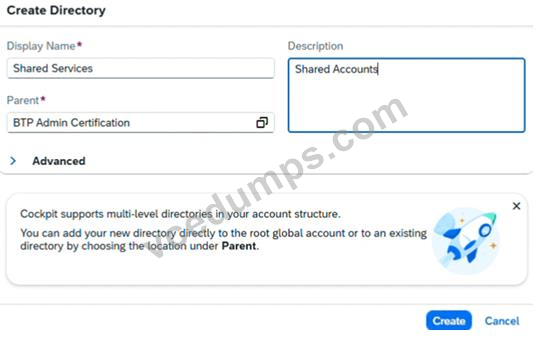
Explanation:
This creates a new top-level directory directly under the global account.
It will be used to hold the shared-services subaccounts.
What to verify
You should now see:
Shared Services
under the global account.
Part B - Create the SH Dev Subaccount
Step 3 - Open the Shared Services Directory
What to do
In the directory list, select Shared Services.
Explanation:
Both required subaccounts must be created inside this directory.
What to verify
You should now be inside the Shared Services directory.
Step 4 - Open Subaccounts
What to do
Inside Shared Services, open Subaccounts.
Click Create → Subaccount.
Explanation:
This opens the subaccount creation screen.
Step 5 - Create SH Dev
What to do
Enter the following:
Display Name / Name: SH Dev
Description: Shared Services Development
Subdomain: btpops####-sh-dev
Set the region as:
Cloud Provider: Amazon Web Services (AWS)
Region: Europe (Frankfurt)
Technical Region / Environment: cf-eu10
Then click Create.
Explanation:
This creates the shared services development subaccount in the required AWS Frankfurt region.
What to verify
After creation, you should see:
SH Dev
inside the Shared Services directory.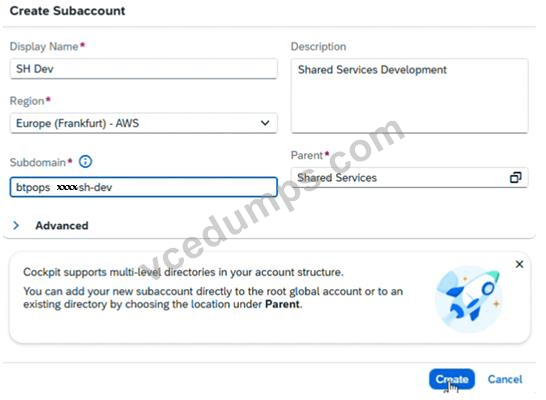
Part C - Create the SH Ops Subaccount
Step 6 - Start a New Subaccount
What to do
Still inside Shared Services, click Create → Subaccount again.
Explanation:
This opens the form for the second required subaccount.
Step 7 - Create SH Ops
What to do
Enter the following:
Display Name / Name: SH Ops
Description: Shared Services Operations
Subdomain: btpops####-sh-ops
Set the region as:
Cloud Provider: Amazon Web Services (AWS)
Region: Europe (Frankfurt)
Technical Region / Environment: cf-eu10
Then click Create.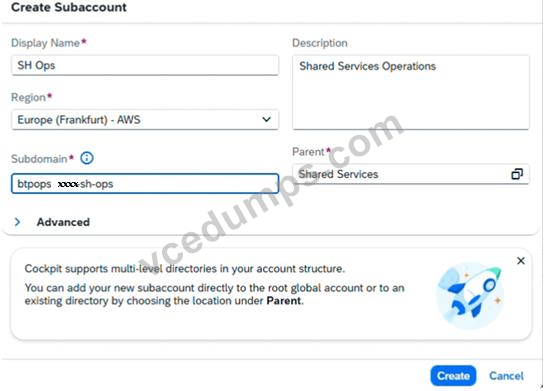
Explanation:
This creates the shared services operations subaccount in the same required region.
What to verify
After creation, you should see:
SH Ops
inside the Shared Services directory.
Final Expected Result for Task 1
You should now have:
Directory
Shared Services
Description: Shared Accounts
Parent: Global Account
Subaccounts inside Shared Services
SH Dev
Description: Shared Services Development
Subdomain: btpops####-sh-dev
Region: AWS → Europe (Frankfurt) cf-eu10
SH Ops
Description: Shared Services Operations
Subdomain: btpops####-sh-ops
Region: AWS → Europe (Frankfurt) cf-eu10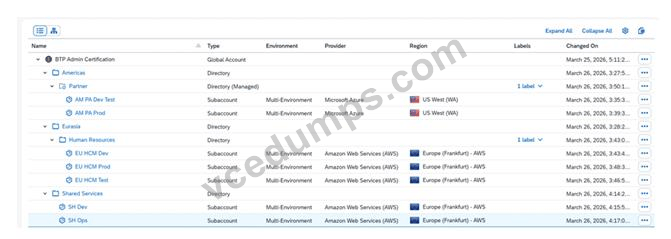
Common Mistakes to Avoid
1. Creating the directory in the wrong place
Shared Services must be created with:
parent = Global Account
2. Creating the subaccounts outside the directory
Both subaccounts must be created inside:
Shared Services
3. Wrong subdomain values
Use exactly:
btpops####-sh-dev
btpops####-sh-ops
Only replace #### with your global account number.
4. Wrong region
Both subaccounts must use:
Amazon Web Services (AWS)
Europe (Frankfurt)
cf-eu10
5. Mixing up SH Dev and SH Ops
Be careful:
SH Dev = Shared Services Development
SH Ops = Shared Services Operations